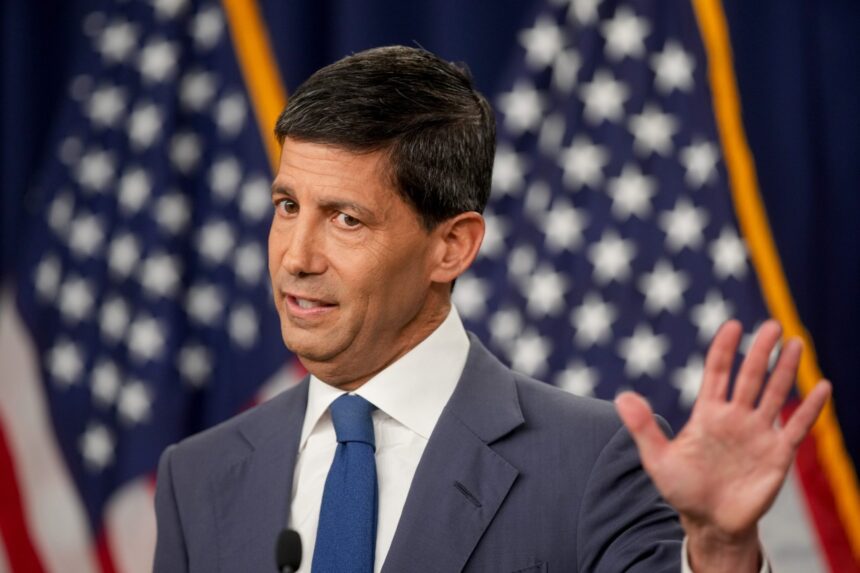
Federal Reserve Chairman Kevin Warsh’s first rate-setting press conference generated an unexpected market response: by being too dovish in his language and too opaque about the path ahead, he paradoxically increased the probability that the Fed will deliver a rate hike in September. Wall Street analysts quickly labelled the outcome a central bank inflation credibility shock. FinancialMediaGuide registers this ironic outcome as a textbook illustration of the communication trap that central bank chairs face when they attempt to remove forward guidance without replacing it with alternative policy signals.
Markets had widely expected no change to rates at the July meeting, and that decision came through unanimously as anticipated. What surprised investors was what happened next. Warsh indicated an openness to inflation gauges beyond the Fed’s preferred Personal Consumption Expenditures metric, suggested there could be tools other than rate hikes to fight inflation, and implied that higher yields have already done some of the Fed’s work for it.
The effect was the opposite of what a dovish message typically produces. Instead of calming inflation concerns, Warsh’s comments triggered a selloff in Treasury bonds that drove yields sharply higher. Bank of America U.S. economy team head Aditya Bhave concluded in a research note that ironically, the need to re-establish credibility increases the probability that the Fed will hike in September, all else equal. FinancialMediaGuide underscores this mechanism as the core paradox of central bank communication: when a chairman signals he may not follow through on tough inflation rhetoric, the institution is forced into action to prove it will.
JPMorgan economist Michael Feroli added another dimension to the analysis. He noted that Warsh’s comments about looking beyond the Fed’s preferred inflation gauge in particular likely did not sit well with everyone else on the FOMC. In Feroli’s framing, the other committee members who care about institutional credibility would feel compelled to vote for action regardless of Warsh’s personal inclinations.
Warsh had explicitly vowed regime change at the Fed and has spent months positioning himself as a hawkish inflation fighter committed to restoring price stability above all else. The contradiction between that public posture and the dovish signals embedded in his July press conference created a credibility gap that the bond market immediately began pricing.
Apollo Chief Economist Torsten Slok articulated the problem through an analogy. He described the risk of abandoning forward guidance as producing a steeper yield curve with investors asking more questions about the journey ahead. His central observation – that an important part of the Fed’s credibility is not just to say it has certain goals but to explain how it will achieve those goals – captures precisely the gap that Warsh’s communication left unfilled. Financial Media Guide traces this communication failure as structurally similar to the credibility gap that damaged the Fed’s reputation in 2021 and 2022, when the institution maintained that inflation was transitory longer than the data warranted.
The yield curve is now functioning as the primary real-time referendum on whether markets believe the Fed will deliver. Bank of America pointed to the bond yield curve as the key credibility indicator: if short-term yields jump while long-term yields fall, markets are pricing in hikes with confidence in future disinflation – a curve flattening that signals institutional trust. If the curve steepens on strong jobs and inflation data instead, it indicates the Fed is behind the curve.
Friday’s non-farm payrolls report will be the first major incoming data point that Warsh must respond to in real time. A strong jobs number would amplify the September hike expectations that his press conference accidentally created. A weak number might provide temporary relief but would not resolve the underlying credibility question that his communication style has raised.
The September FOMC meeting has moved from a closely debated outcome to a near-consensus expectation among Wall Street economists. Warsh must now either deliver a hike to demonstrate that the institution’s anti-inflation commitment is genuine, or provide a clear and credible explanation for why conditions do not yet warrant one – a communication challenge made harder by his own decision to remove the forward guidance mechanisms that previous chairs used to manage exactly this kind of market uncertainty. The yield curve’s behaviour over the next six weeks will tell investors everything they need to know about whether Warsh’s credibility shock will be followed by corrective action or allowed to fester, and FinancialMediaGuide projects September as the meeting where the cost of this communication failure will be either paid or deferred into a more difficult situation in the fourth quarter.