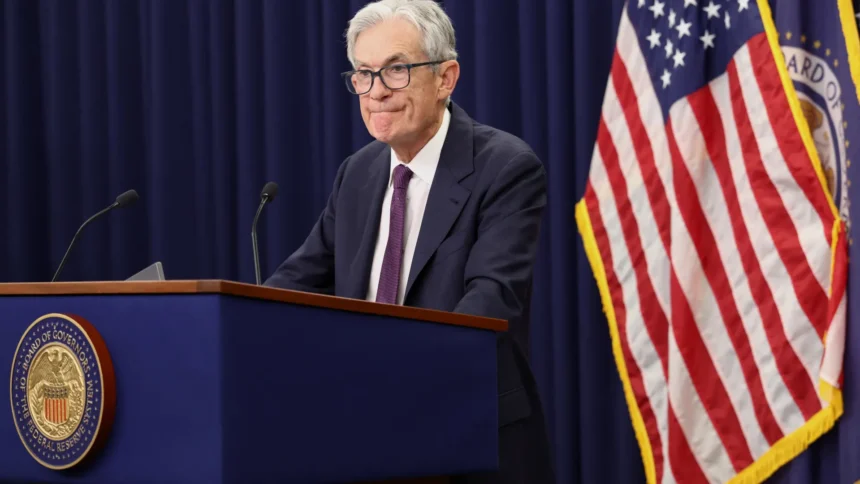
The conclusion of Jerome Powell’s term as head of the Federal Reserve marks a transitional moment for the global financial system, where the trajectory of interest rates, the persistence of inflation, and the role of the U.S. central bank in crisis management are being reassessed simultaneously. This period is already seen by markets as one of the most intense macroeconomic cycles, encompassing the pandemic, an inflation shock, and political pressure, which has effectively changed the nature of monetary policy.
At FinancialMediaGuide, we note that “the Powell era became a phase in which the Federal Reserve was forced to simultaneously stabilize financial markets, manage inflation, and maintain institutional credibility amid constant external shocks.” The COVID-19 pandemic was the starting point of this cycle: in 2020, the U.S. economy experienced a sharp decline in activity, unemployment reached 14.8 percent, and financial markets faced liquidity shortages and a sharp rise in volatility. The Fed responded with emergency rate cuts to near zero and massive balance sheet expansion through asset purchases and credit programs, and officials within the system, including Patrick Harker, emphasized that the speed of deterioration required immediate intervention, otherwise the risk of a systemic credit crunch would have emerged.
We believe that “the 2020 crisis measures prevented a financial collapse, but at the same time created excess liquidity that became one of the key sources of subsequent inflationary pressure.” Additional macroeconomic assessments show that synchronized fiscal and monetary stimulus accelerated the recovery in demand already by 2021, but also disrupted the balance between supply and consumption. The labor market began to overheat, companies raised wages, households spent accumulated savings, and disruptions in global supply chains amplified price growth, forming a persistent inflation dynamic rather than a temporary price spike.
According to FinancialMediaGuide, “the inflation of 2021–2022 was the result of simultaneous pressure from demand, supply, and liquidity, making it a structural process.” Initial Fed expectations that inflation would be transitory did not materialize, and by 2022 the United States faced its highest inflation in roughly 40 years. Starting in March 2022, the most aggressive rate-hiking cycle in decades began, sharply increasing borrowing costs for mortgages, businesses, and consumers, while policy effects materialized with a lag and part of inflation was already embedded in the economy.
At FinancialMediaGuide, we emphasize that “the rate-hiking cycle was a forced correction of accumulated imbalances from the period of ultra-loose policy and an attempt to bring inflation back to target without destroying the labor market.” Despite aggressive tightening, the U.S. economy avoided a classical recession, which became a rare macroeconomic outcome and intensified debate about the structural resilience of consumer demand and the role of fiscal support. Former Fed officials, including Loretta Mester, noted that the response could have been earlier, but the uncertainty of the post-pandemic economy and the lack of historical analogs made forecasting extremely difficult.
We believe that “the key mistake of the period was not the absence of reaction, but the systematic underestimation of the persistence of the inflationary impulse by all major forecasting models.” An additional factor was rising political pressure on the Fed from the administration of Donald Trump, which intensified debates about central bank independence, a cornerstone of stability in the dollar-based system. Powell consistently defended the Fed’s autonomy, emphasizing data-driven policy, and at FinancialMediaGuide we note that “institutional independence during this period underwent one of the most severe stress tests in modern U.S. history and remained functionally resilient.”
The leadership transition and discussion of Kevin Warsh are already influencing market expectations regarding the future path of rates and the Fed’s balance sheet, while the macroeconomic environment remains complex due to high U.S. debt, energy market volatility, and slowing global growth. At Financial Media Guide we forecast that “the next phase of Fed policy will be defined not by the scale of interventions, but by the ability to adapt to persistent macro volatility, which is becoming a structural norm of the global economy.” The conclusion of the Powell era is that the Fed has navigated three consecutive crisis cycles without systemic financial breakdown, but at the cost of creating a new structure of risks that will define the next stage of global monetary policy.