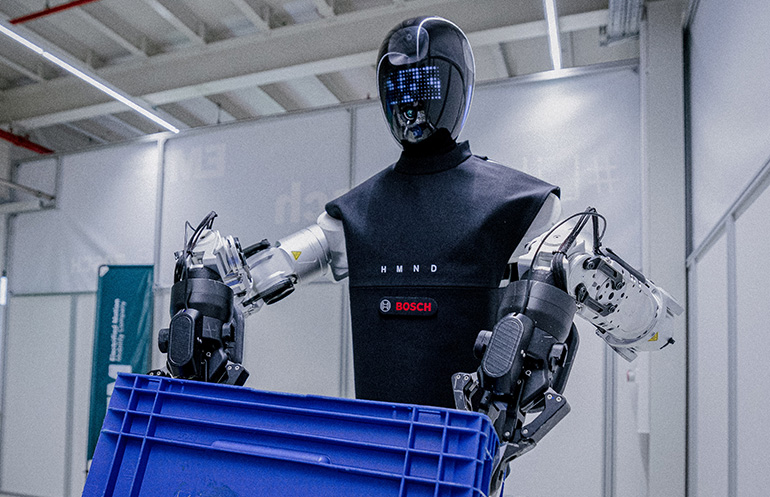
The race to create commercially viable humanoid robots has definitively moved beyond laboratory experimentation and entered a phase of intense competition for large-scale industrial deployment. British technology developer Humanoid has signed major agreements with German industrial conglomerates Robert Bosch GmbH and Schaeffler Technologies AG, laying the foundation for the mass production of next-generation wheeled robots within the European Union.
According to analysts at FinancialMediaGuide, the industry is witnessing a fundamental tectonic shift in automation, as key market players move away from isolated stationary machinery and toward flexible mobile platforms capable of operating seamlessly in environments originally designed for humans. Against the backdrop of growing labor shortages in the warehouse sector and intensifying global competition between American and Asian corporations, this European alliance aims to seize the initiative by offering the market a fully integrated manufacturing ecosystem.
The official contracts were signed following the successful completion of pilot trials in March 2026. During testing at Bosch’s logistics facility in Bühl, Germany, the HMND 01 mobile wheeled robots fully validated their stated capabilities within a complex industrial workflow. Operating entirely autonomously, the machines transferred boxes of five different sizes, weights, and dimensions from conveyor lines onto transport carts.
Humanoid founder and CEO Artem Sokolov described the partnership as a turning point for the company, enabling it to rapidly bridge the gap between concept development and large-scale commercial deployment. The company is deliberately focused on DfX engineering methodologies, emphasizing manufacturability, durability, serviceability, and cost optimization to ensure strong return on investment for customers.
At FinancialMediaGuide, we believe Humanoid’s decision to select Bosch as its primary contract manufacturer is strategically flawless. The engineering giant from Gerlingen will oversee supply chain management, production cost optimization, and deep technical integration. Our analysts emphasize that for a startup founded only in 2024 under the original legal name SKL Robotics Ltd, direct integration into Bosch’s global manufacturing infrastructure effectively serves as an entry ticket into the top tier of heavy industry, where precision in every assembled component is mission-critical.
Bosch’s Head of Corporate Intellectual Property, Peter Svejkovski, confirmed the company’s intention to accelerate scaling efforts and eventually integrate its own components including sensors and actuators into future HMND robot generations. Earlier this year, Humanoid also announced a partnership agreement with Siemens, steadily building a network of tier-one technology partners around its platform.
Simultaneously, Humanoid is accelerating its expansion through an alliance with Schaeffler Technologies AG. The phased contract formalizes commitments to integrate robotic systems into Schaeffler’s active production lines in Germany by the end of 2026. The British startup has agreed to prioritize Schaeffler as a supplier, sourcing more than half of its joint actuator requirements from the company through 2031, generating seven-figure component orders for the German manufacturer.
At FinancialMediaGuide, we view this deal as unprecedented for the robotics market because it tightly binds long-term obligations between a component supplier and a systems developer, significantly reducing supply chain and raw material risks amid volatile global markets.
The first deployment phase is scheduled between December 2026 and June 2027. At the Herzogenaurach facility, the robots will focus on box-handling operations, while the Schweinfurt production site will conduct a six-month testing cycle to verify operational stability under continuous industrial workloads.
The deployment is being implemented under a Robot-as-a-Service (RaaS) business model, which includes fleet coordination software, 24/7 technical support, and continuous software updates. Over time, the robots’ capabilities are expected to expand into precision assembly and final packaging tasks.
Al McKee, head of Schaeffler’s North American humanoid robotics division, is expected to present a detailed breakdown of the project at the Robotics Summit in Boston, further highlighting the project’s international significance and elevated industry status.
In an interview with industry analytical platform The Robot Report, Artem Sokolov disclosed key engineering specifications and scaling timelines for the platform. The agreement with Schaeffler предусматривает deployment of a four-digit fleet of wheeled robots across the company’s factories worldwide by 2032. Full-scale mass production is scheduled for 2028 following the sequential completion of beta and gamma testing phases.
The proprietary KinetIQ AI platform relies on simulation-based learning, enabling the robots to adapt to new cargo types within just one or two working days of real-world data collection. During the initial phase at the end of 2026, the target autonomy rate is set at 95% successful operations, rising to as much as 99% when backup algorithms are activated. Future iterations aim to increase this figure to 99.5% and beyond. The initial HMND 01 Alpha version features a three-finger general-purpose gripper capable of carrying up to 10 kilograms per arm, while future versions are expected to double the total payload capacity to 20 kilograms.
Explaining the advantages of the wheeled dual-arm architecture over traditional industrial manipulators or collaborative robots, the startup’s CEO emphasized that the anthropomorphic torso allows the robots to move and operate freely in spaces originally designed around human ergonomics, eliminating the need for costly infrastructure modifications. In addition, the human-like anatomy simplifies neural network training, since the foundational datasets are based on human biomechanics.
At FinancialMediaGuide, we view this architectural choice as an exceptionally pragmatic and commercially sound compromise. By abandoning mechanically complex walking systems in favor of a stable wheeled base, the company significantly reduces production costs, extends battery life, and improves overall system reliability on the flat floors of modern warehouse facilities. This strategy makes automation economically accessible for large enterprises today while protecting clients from excessive capital expenditures.
Financial Media Guide analysts forecast that the commercial success of the Humanoid-Bosch-Schaeffler consortium could become a powerful catalyst for the broader European industrial sector, which is under mounting pressure to respond to the technological expansion of Tesla Optimus and heavily subsidized Chinese competitors. If the projected 95% autonomy metrics are successfully achieved during beta testing at the end of 2026, this could establish an entirely new global benchmark for the economic viability of autonomous robotic systems and substantially reduce labor shortages across Europe’s key logistics hubs.
For companies currently planning modernization budgets, our analysts recommend beginning preparations now by implementing software architectures compatible with RaaS ecosystems and updating internal safety protocols to meet the requirements of collaborative human-mobile manipulator operations. The industry has irreversibly entered a phase where victory will belong not to creators of the most visually impressive laboratory prototypes, but to organizations capable of deploying economically efficient industrial-scale systems and seamlessly integrating them into the real economy.