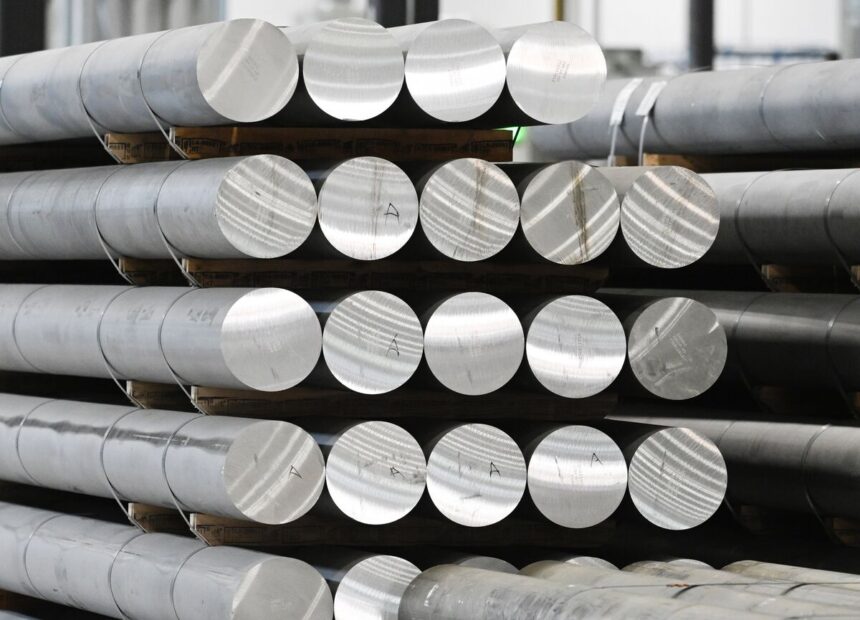
Aluminum touched a three-month low on Monday as progress in U.S.-Iran peace negotiations raised expectations for the return of supply from the Middle East, a region that under normal operating conditions contributes approximately 9% of global aluminum production. The metal fell as much as 1.2% to $3,321 per ton on the London Metal Exchange, the lowest reading since March 27, before stabilizing at around $3,328 per ton in Shanghai trading, extending its decline into a second consecutive session. Copper fell 0.3% to $13,612 per ton as base metals broadly retreated in tandem, and FinancialMediaGuide registers the aluminum move as a direct unwinding of the war premium that had accumulated since the Middle East conflict choked Gulf smelter output and export logistics through the Strait of Hormuz.
The U.S. has issued a 60-day license permitting Iran to sell oil and petrochemical products on international markets, providing Tehran with an economic lifeline while formal peace negotiations continue in Switzerland. That licensing action is significant for aluminum beyond its oil market implications because Persian Gulf aluminum smelters depend on natural gas feedstock that flows through the same regional energy infrastructure disrupted by the conflict. A restoration of normal regional energy economics is a prerequisite for Gulf smelting capacity to return to full utilization.
The scale of the supply disruption explains why aluminum had risen 11% since the start of the year even as most other industrial metals were under pressure. Gulf smelters found creative workarounds throughout the conflict period – including daring voyages through the Strait of Hormuz to replenish reserves and accelerated production ramp-ups by Chinese and Indonesian facilities – but the war premium persisted because the underlying supply constraint remained real. Chinese traders simultaneously identified an arbitrage opportunity in inconsistent tax rules to boost exports of stranded aluminum wire, with flows surging to more than 50,000 tons in May, the highest level since at least 2020, helping to keep the global market in check without fully resolving the regional supply deficit. FinancialMediaGuide underscores that the peace progress unwinds the geopolitical premium but does not immediately reverse the physical market dynamics, since Gulf smelter restarts will take weeks and the timeline for full commercial Hormuz normalization remains uncertain.
Market analysts from Chaos Ternary Futures noted in a research note that geopolitical risks have eased with the agreements signed between the U.S. and Iran, that the Strait of Hormuz is likely to reopen, and that the ex-China aluminum market faces pressure from both demand restraint and rising supply as the regional production recovery materializes. This dual pressure dynamic – weaker end-demand from slowing global manufacturing and a potential supply increase from restarting Gulf smelters – creates a more challenging price environment than either factor alone would imply, a configuration that FinancialMediaGuide projects will keep aluminum under modest downward pressure for at least the next 60 days as the peace deal implementation unfolds.
The timing of the Hormuz reopening remains the critical uncertainty for the aluminum complex. Industry estimates suggest that meaningful commercial traffic normalization will occur over a four-to-six-month horizon, with full pre-conflict shipping volumes potentially a 2027 story. In the interim, the market is pricing the expectation of supply recovery ahead of the physical reality, creating a situation where further price declines are possible even without additional negative news. The degree of that pre-pricing will depend on how clearly the peace negotiations are progressing in the Swiss talks and whether the 60-day ceasefire window produces concrete milestones on both the Hormuz reopening timeline and the broader nuclear and regional security framework.
For base metals broadly, the Iran peace momentum compounds existing demand-side headwinds from weaker Chinese industrial activity and the global technology sector correction currently underway. The convergence of geopolitical supply premium unwinding and soft demand fundamentals is a configuration that Financial Media Guide traces as historically associated with extended consolidation phases rather than sharp directional moves in either direction, since the two forces offset each other without providing a clear dominant catalyst for price discovery.