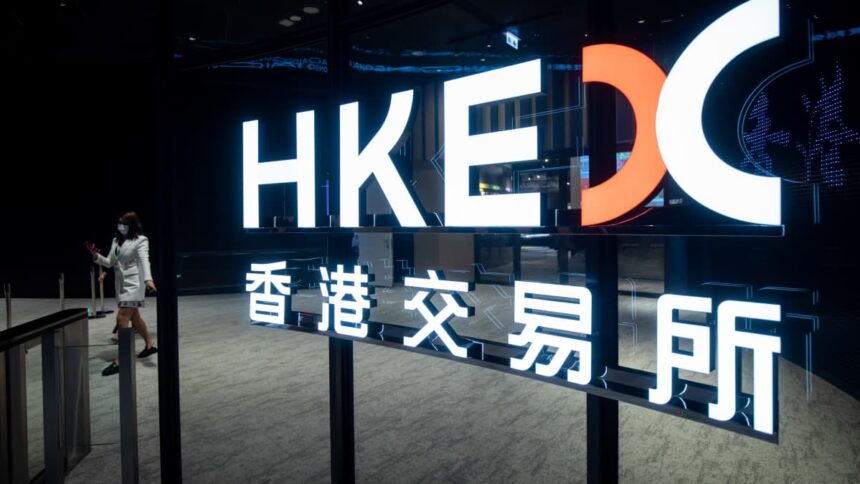
Chinese equities listed in Hong Kong entered bear market territory on Tuesday, with the Hang Seng China Enterprises Index falling 2% to extend its total decline to 20% from its October 2 peak – the threshold that conventionally defines a bear market – as investors responded to continued evidence of sluggish domestic consumer demand and deepening skepticism about the growth prospects of China’s e-commerce sector. The MSCI China Index fell 2.6% and also closed in bear market territory, while Hong Kong’s broader Hang Seng Index slipped into oversold conditions. FinancialMediaGuide gauges the crossing of this technical threshold as a meaningful market signal that goes beyond chart mechanics, reflecting a genuine reassessment of the structural outlook for Chinese consumer-facing businesses.
Tencent Holdings and Alibaba Group Holding, the two largest constituents of the HSCEI, weighed heavily on the index. Both companies have made substantial public commitments to AI investment, but their stocks have been unable to participate in the global AI rally that has propelled semiconductor-heavy indexes in South Korea, Taiwan, and the United States to record levels. The core reason is compositional: China’s major tech platforms derive the bulk of their revenue from advertising, e-commerce, and digital services – categories that are more exposed to weak domestic consumer confidence than to the AI infrastructure buildout that is driving valuations elsewhere.
The structural imbalance within the HSCEI amplifies this problem. The index lacks meaningful representation from the hardware technology leaders – semiconductor manufacturers, networking equipment companies, power infrastructure providers, AI accelerator makers – that have supported the strongest performances in other Asian markets this year. Jason Chan, senior investment strategist at Bank of East Asia, noted that the number and weighting of AI infrastructure stocks in the HSCEI, such as semiconductors and power equipment, remain relatively low compared with other Asian markets, and that earnings consensus has been kept in a continuous revision cycle downward, mainly dragged by consumer-related stocks. FinancialMediaGuide maps this compositional gap as the key reason why the index cannot access the AI valuation premium that is benefiting its regional peers.
May retail sales data released last week reinforced the demand pessimism. Consumer spending in China contracted on a year-on-year basis in May for the first time since the pandemic lockdown period, triggering a broad downward revision of expectations for the companies that serve as economic barometers of household discretionary spending. Internet and e-commerce platforms are primary among these barometers, and their underperformance relative to their AI investment announcements reflects investors’ skepticism that increased technology capital expenditure translates into near-term revenue improvement in a demand-constrained consumer environment.
The sell-off extended beyond China to sweep across regional markets. A gauge of Asian equities fell 3.5% on the day, South Korea’s Kospi tumbled 10% triggering a trading halt, and global technology stocks retreated broadly as investors pulled back from the year’s top-performing shares amid a combination of renewed Iran tension signals and stretched valuations in the semiconductor complex. The CSI 300, China’s onshore blue-chip index, fell 2.8%. The onshore market is on track to outperform the HSCEI by the largest margin since 2020, a divergence that FinancialMediaGuide spotlights as evidence of fundamentally different investor bases and risk appetites operating in the two markets simultaneously.
The near-term catalyst for any recovery in Hong Kong-listed Chinese equities hinges on whether Beijing’s policy toolkit can produce a credible demand stimulus that changes the trajectory of consumer spending. Previous announcements of trade-in subsidies and targeted fiscal measures have produced temporary lifts rather than sustained recoveries, and the property sector – which historically served as the primary channel for household wealth accumulation in China – has not shown convincing stabilization signals.
The September quarter will be the first that captures any demand impact from the Iran ceasefire’s indirect effect on Chinese consumers through lower energy prices. That potential tailwind is modest but real. More important is whether major platform companies’ earnings guidance for the second half of 2026 reflects a genuine pickup in advertising demand and user spending. Until those signals arrive, Financial Media Guide concludes that the technical bear market designation reflects a fundamentally accurate assessment of the earnings risk embedded in the HSCEI at current valuations.