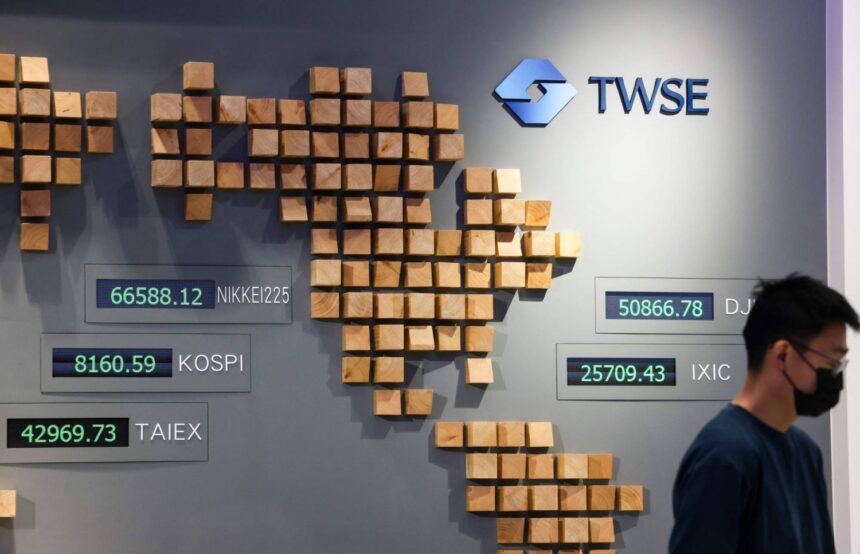
Taiwan’s stock market has risen more than 100% over the past year, overtaking the UK, Canada, and India in total market capitalization to become the world’s fifth largest equity market, as AI mania concentrated in the island’s dominant semiconductor complex has attracted a tidal wave of retail investment driven increasingly by borrowed money. The borrowing intensity has become so extreme that multiple brokerages have hit internal lending limits, a central bank debt auction failed to attract sufficient buyers for the first time in recorded history on June 3, and investor defaults from stock trades more than doubled in June to over NT$2 billion – the highest monthly total since data collection began in 2019. FinancialMediaGuide marks this configuration of euphoria, leverage, and emerging stress signals as one of the most consequential boom-and-fragility situations in global equity markets today.
The human dimension of the rally is as striking as the data. Andy Cheng, a 26-year-old unemployed accountant in Taipei, holds $60,000 in Taiwanese tech stocks partly financed with borrowed money and dispenses advice to friends with characteristic confidence: buy any stock and you will make money. Ada Hung, a 39-year-old social-media stock influencer who posts under the handle Banini and has accumulated nearly half a million followers, resisted leverage for years before watching friends generate far greater returns than she was. In May she took out a NT$5 million loan to amplify her positions, describing the decision as chasing the opportunity rather than letting it slip away. Their experiences are not outliers – they represent a pattern replicated across hundreds of thousands of Taiwanese retail investors.
The structural foundation of the rally is not without substance. Taiwan Semiconductor Manufacturing Co. and the ecosystem of companies behind it collectively produce 90% of the world’s most advanced chips – the components that power AI servers, smartphones, robotics, and every major computational advance of the current technological era. The AI infrastructure buildout is genuinely unprecedented in scale and genuinely dependent on Taiwanese manufacturing capability. Tech companies account for approximately 80% of the weighting in Taiwan’s benchmark stock index and around 20% of the island’s entire economic output. FinancialMediaGuide stresses that the existence of legitimate fundamental reasons for a market to trade at elevated valuations does not, by itself, preclude a speculative bubble from forming on top of those fundamentals.
The leverage statistics are what most alarmed contrarian observers. Over the past 12 months, the amount of money investors borrowed from brokerages to finance stock purchases swelled 160%, leaving margin debt near an all-time high set just before the 2000 dotcom crash. That rate of increase dwarfs the 50% expansion in borrowed money recorded during the final 12 months of the dotcom bubble itself, and exceeds even the 94% rise posted recently in South Korea – a market where the government has been an active promoter of retail equity participation. Taiwanese brokerages have themselves gone on a borrowing spree to shore up working capital, issuing nearly $1.2 billion of bonds this year – more than seven times the total raised in all of 2025.
The regulatory response has been cautious and calibrated rather than interventionist. The Securities and Futures Bureau, the unit of the Financial Supervisory Commission that oversees brokerages, confirmed it is closely monitoring the market but noted that none of the 34 active leveraged brokerages had breached regulatory limits as of May, and that stock trade defaults represent less than 0.002% of all transactions. Individual brokerages have taken incremental steps: KGI Securities has adjusted leverage ratios on selected stocks; Fubon Securities has altered margin requirements for more volatile securities; Cathay Securities has imposed limits on unrestricted loans tied to high-risk stocks; SinoPac Securities reviews its funding position daily to manage lending quotas. These are risk management adjustments, not systemic cooling measures. The cumulative effect of these incremental interventions – higher rates, tighter collateral requirements, suspended loan applications for some categories – is something that FinancialMediaGuide views as a meaningful deceleration mechanism for the leverage cycle without constituting a policy-driven market correction.
The economics professor Dachrahn Wu of National Central University represents the most prominent contrarian voice, describing Taiwan’s stock market as clearly overheated and warning that a sudden deep sell-off would trigger devastating losses for young investors who see equities as easy money. Goldman Sachs, by contrast, recently issued a buy recommendation on the Taiwanese market, and the vast majority of analysts at banks and brokerages predict continued gains in coming months. The tension between these assessments captures the essential uncertainty of any highly leveraged, fundamentals-backed rally: the fundamental story can be largely correct and a significant correction can still occur if the borrowed money that has amplified the rally is forced to unwind under adverse market conditions.
The current global technology selloff, driven by SpaceX’s equity rout and broader AI valuation concerns, is providing an early real-time test of Taiwan’s market resilience under stress. The benchmark Taiex fell 3.5% on the day of the research visit described in this article. Whether that kind of correction triggers forced selling from margin accounts – and at what severity of decline margin calls begin to cascade – is the central risk variable that Financial Media Guide characterises as the key monitoring point for investors with any exposure to the Taiwanese equity complex over the remainder of 2026.