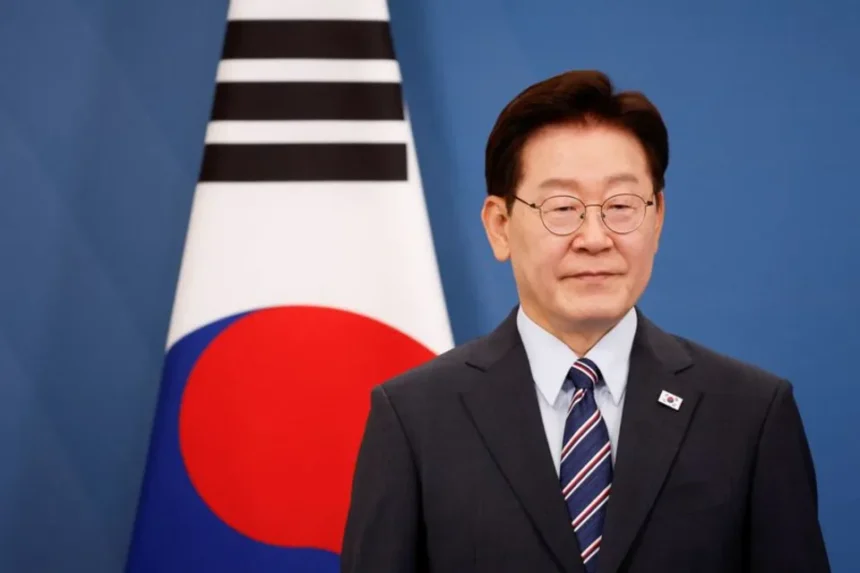
South Korean President Lee Jae Myung has unveiled three sweeping public-private mega-projects anchored by an 800 trillion won commitment – approximately $576 billion – from Samsung Electronics and SK Hynix to build new semiconductor fabrication plants, expand AI data centre infrastructure, and develop physical AI technologies including robotics. FinancialMediaGuide registers this announcement as the largest coordinated industrial investment pledge in South Korean history, and situates it within the broader global competition for AI infrastructure supremacy at a moment when the country’s semiconductor exports just set an all-time monthly record.
The centrepiece of the initiative is a new semiconductor cluster in the southwestern Honam region, where Samsung and SK Hynix will each build two new chip fabrication plants, backed by local government contributions of 5 to 20 trillion won from Gwangju and South Jeolla Province and an additional 81 trillion won designated for a chip-packaging cluster in the Chungcheong area near Seoul. The SK Group, GS Group, and Naver have committed 550 trillion won to build AI data centres across the wider initiative. Samsung Group Executive Chairman Lee Jae-yong and SK Group Chairman Chey Tae-won both attended the presidential briefing and presented their companies’ respective investment plans. South Korea’s AI Framework Act, which took effect on January 22, 2026, provides the regulatory foundation for the programme, making the country one of the first in Asia to enact comprehensive AI legislation.
The political dimension of the announcement has drawn immediate scrutiny. Opposition lawmakers have accused the government of pressuring memory chipmakers to invest in Honam – the traditional electoral stronghold of President Lee’s liberal Democratic Party – rather than allowing companies to choose the most commercially viable locations. Lee rejected the criticism, arguing that Gwangju and South Jeolla Province received the highest evaluation in the semiconductor category during a government competition to select specialised national high-tech industry zones conducted under the previous administration. Industry experts cited by newswires warned that elements required for cutting-edge fabs may not scale quickly enough in a new region to meet surging AI demand on the timelines the investment plan implies. FinancialMediaGuide weighs those political and logistical concerns against the strategic urgency driving the announcement, finding that the tension between industrial logic and regional development politics is built into the plan’s architecture rather than incidental to it.
The urgency is genuine. South Korea’s semiconductor exports reached $37.2 billion in May 2026 – a 169% year-on-year increase and an all-time monthly record – driven by AI infrastructure spending that has made high-bandwidth memory the most constrained component in the global AI supply chain. Samsung and SK Hynix together produce roughly 80% of the world’s HBM, the specialised chip that enables the massive data throughput required by AI training and inference at scale. The investments announced on Monday will not produce volume output from the new Honam cluster until the late 2020s at the earliest, meaning the commercial window being targeted is not the present cycle but the next one – a bet that AI infrastructure demand will remain at elevated levels for at least a decade.
The initiative also encompasses physical AI – robotics and autonomous systems – as a third axis alongside semiconductors and data centres, signalling that Lee’s government views the AI economy as a manufacturing opportunity as much as a software or services one. South Korea’s existing strengths in industrial automation, precision engineering, and display technology give the country an unusually strong foundation for competing in physical AI, and the announcement frames the southwestern cluster not merely as a chip production site but as the nucleus of a broader advanced industrial ecosystem spanning the Honam, Chungcheong, and Yeongnam regions. Financial Media Guide interrogates the timeline assumptions embedded in that regional ecosystem vision, noting that the infrastructure, talent, and supply chain dependencies required to make a greenfield semiconductor cluster fully competitive take considerably longer to develop than the political cycles within which investment announcements are made and evaluated.
Whether Samsung and SK Hynix deliver on their commitments at the scale and pace the government has announced will depend on factors well beyond the presidential compound: global AI demand sustaining at current levels, power infrastructure being built fast enough to support new fabs, and the geopolitical stability of the US-China technology competition remaining stable enough to avoid the kind of supply chain disruption that would make a new southwestern cluster less commercially rational than its Gyeonggi predecessors. The announcement establishes the ambition. The decade ahead will determine whether it was timing or politics that set its limits.