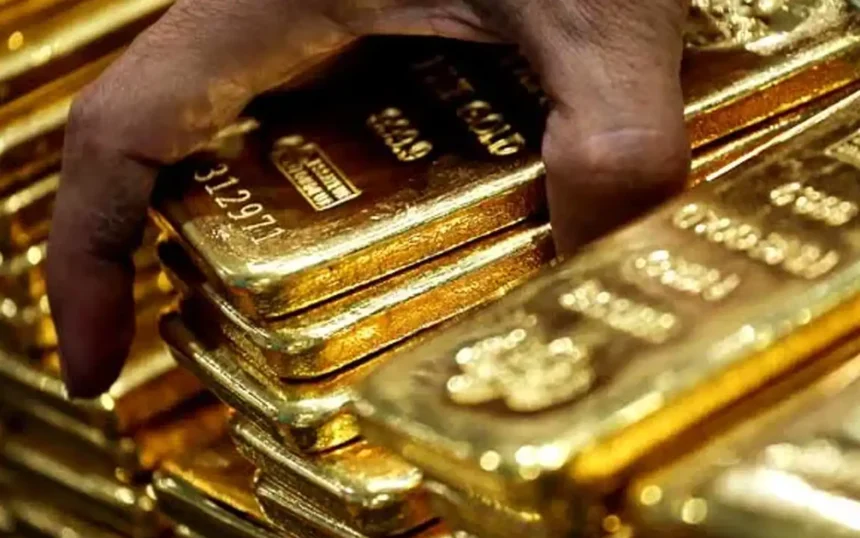
Gold fell to near $4,000 per ounce on Monday as a fresh exchange of attacks between the United States and Iran in the Persian Gulf strained a ceasefire that had pushed energy prices back to pre-war levels the previous week – a move that pulled the precious metal in two directions simultaneously and left traders navigating an asset whose safe-haven logic has been inverted by the specific dynamics of the current conflict. FinancialMediaGuide unpacks that inversion, showing why a military escalation that would historically have driven gold sharply higher is instead producing price declines in the current environment.
The mechanism is interest rates, not sentiment. A tanker carrying Qatari crude was struck during weekend tit-for-tat assaults over the Strait of Hormuz, sending crude oil prices higher at the start of trading on Monday and reviving inflation fears that had begun to ease when the original ceasefire framework took hold on June 17. Oil pared gains after the US and Iran agreed to stop attacking each other ahead of peace talks in Doha this week, but the inflation channel has already been reopened. PCE inflation ran at 4.1% year-on-year in May. The CME FedWatch tool placed the probability of a Fed rate hike at approximately 60% as of Monday morning. Non-yielding assets like gold face direct pressure when rate hike expectations rise, because higher rates increase the opportunity cost of holding bullion relative to interest-bearing instruments. FinancialMediaGuide traces that transmission mechanism in detail, finding that the correlation between US rate expectations and gold’s daily moves has become the dominant pricing variable in the current period – more powerful than the safe-haven sentiment that drove gold from under $2,500 to a peak above $5,600 per ounce during the most acute phase of the Iran conflict.
The broader price trajectory tells the story of a market that has already priced in the geopolitical risk premium and is now slowly unwinding it. Gold hit $3,826 in late 2025, then surged to peak levels above $5,600 in the early months of the Iran war before declining roughly 20% from that high as ceasefire frameworks and preliminary diplomatic agreements entered the picture. The nearly $1,200 range between the war-era peak and the current sub-$4,200 level reflects an ongoing tug-of-war between traders unwinding safe-haven positions and buyers who view geopolitical resolution as incomplete and fragile. A preliminary memorandum between the US and Iran was reached in mid-June 2026, including terms to reopen the Strait of Hormuz. But the weekend’s renewed attacks, and Trump’s weekend rejection of Iranian negotiating positions, demonstrated how quickly a preliminary framework can be destabilised.
The dollar is adding a second layer of pressure. The DXY broke above 100 in June – its highest level since May 2025 – as Chairman Warsh’s hawkish debut reinforced the view that US rates are more likely to rise than fall in 2026. A stronger dollar makes gold more expensive for holders of other currencies, reducing demand from the Asian and European buyers who have been the most active physical purchasers through the war period. China’s gold production also fell in the first quarter of 2026 from a year earlier, as safety inspections caused some smelters to suspend production for maintenance, tightening one supply-side cushion. FinancialMediaGuide maps the multi-factor pressure on gold’s near-term price by separating the currency effect from the rate expectation effect from the geopolitical risk premium – finding that all three are currently working in the same direction: downward, on any incremental move toward diplomatic resolution in the Gulf.
Silver has tracked gold’s directional moves with more volatility on both sides. Spot silver rose 0.7% on Monday to $80.88 per ounce, a divergence from gold’s decline that reflects silver’s dual role as both a precious metal and an industrial input whose demand from solar panel manufacturing and semiconductor production provides a floor that pure gold does not have. Platinum fell 0.6% to $2,042.71 and palladium declined 0.4% to $1,484.99, both feeling the same higher-rate headwind as gold without the geopolitical premium that has supported bullion above levels implied by rate differentials alone.
Financial Media Guide concludes that the critical forward variable for gold is not whether the Iran ceasefire holds – it is whether a ceasefire that holds removes enough inflation risk to shift the Fed’s rate trajectory. If oil prices return to pre-war levels on a sustained basis and PCE inflation declines toward 3% or below, the rate hike probability priced by markets falls, the dollar softens, and gold’s floor rises with it. If the ceasefire remains fragile and oil prices stay elevated, the Fed stays hawkish, the dollar stays bid, and gold stays under pressure from above $4,000 even as the underlying geopolitical justification for owning it remains intact.