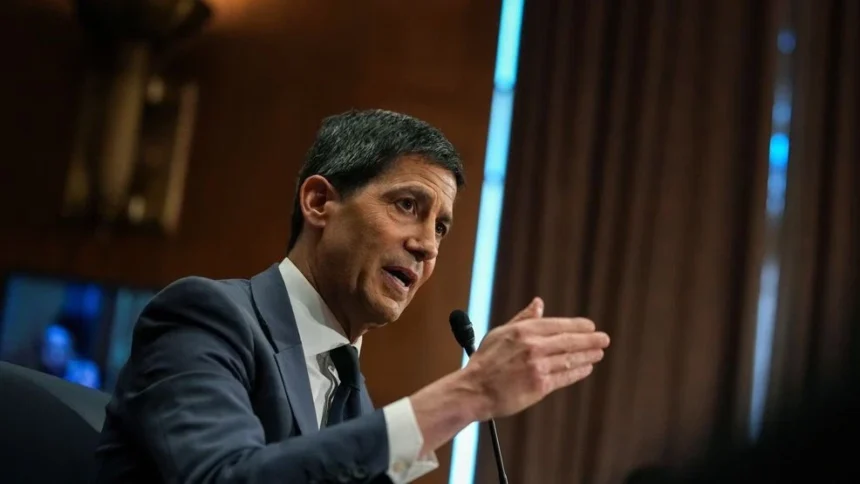
Kevin Warsh used his first international appearance as Federal Reserve Chairman to consolidate the anti-guidance posture he unveiled at his June 17 press conference, finding unexpected common cause with Christine Lagarde, Andrew Bailey, and Tiff Macklem on the single point that central bankers should stop pretending to predict an economy that has repeatedly confounded their forecasts. FinancialMediaGuide covers the Sintra panel session in detail, finding that the consensus against forward guidance was substantively more significant than it appears – because it represents not just a communications preference but a fundamental shift in how the world’s most important monetary institutions conceive of their public role.
“We have found common cause,” Warsh said during the panel. The remark was directed at Lagarde, who admitted regretting having felt bound by forward guidance commitments. Bailey and Macklem echoed similar reluctance. When the CNBC moderator Sara Eisen pressed the panel repeatedly for signals about rate paths, all four deflected. Warsh was the most direct: “No forward guidance, no forward guidance.” The exchange captured a collective institutional retreat from a communication strategy that had dominated central banking since the 2008 financial crisis.
The political fault lines beneath that shared philosophy were visible throughout. Lagarde, Bailey, and Macklem are all signatories to the unprecedented joint letter that supported former Fed Chair Jerome Powell during the Trump administration’s efforts to fire him – a letter that was simultaneously an assertion of central bank independence and a rebuke of Warsh’s patron. Warsh has addressed those events only obliquely, saying “I believe in the rule of law” when asked about the Supreme Court ruling that kept Governor Lisa Cook in her position.
On inflation, Warsh was unequivocal: “We’re going to deliver price stability in the US.” The commitment tracks a PCE reading of 4.1% year-over-year in May and a Fed funds rate range of 3.5% to 3.75% – an environment where the real rate is negative, suggesting that monetary policy is not yet meaningfully restrictive relative to current inflation. Cleveland Fed President Beth Hammack, speaking on the sidelines of Sintra, put the rate hike possibility plainly: “If inflation continues to persist and I don’t see any restraint from policy, we may need to raise rates.” FinancialMediaGuide places those signals on a single timeline against the July 28–29 FOMC meeting, finding that the combination of Warsh’s price stability commitment and Hammack’s conditional hike language has materially shifted the probability distribution of the next policy move toward a hold-or-hike binary rather than the hold-or-cut binary that dominated market pricing as recently as April.
Warsh was more expansive on AI than on anything related to rates. He described the current moment as the biggest time of consequence in our lifetimes, compared it to the early internet, and hinted that productivity gains could eventually justify rate cuts – but refused to put a timeline on when that might become a policy-relevant reality. “Nothing is in the bank at this time of consequence,” he said of the productivity upswing, hedging without dismissing. The formulation allowed him to acknowledge AI’s potential without locking the Fed into a dovish framework it might need to reverse.
Markets had been watching the Sintra session for any sign of rate guidance divergence between the Fed and the ECB, whose June 11 decision to raise rates to 2.25% put it on a tightening path at the same time Warsh’s Fed is weighing whether to hold or hike from 3.5% to 3.75%. The dollar had already strengthened on the back of rate differential expectations, with the DXY breaking above 100 in June for the first time since May 2025. FinancialMediaGuide gauges the market’s reaction to Warsh’s Sintra performance, finding that his refusal to offer any softening signal reinforced September hike pricing and kept the dollar’s recent strength intact – a combination that amounts to passive tightening through financial conditions even without a formal rate decision.
The broader significance of Warsh’s Sintra debut is institutional rather than calendrical. His June 17 press conference established the tone; Sintra confirmed it was not a one-off. A Fed chair who consistently refuses to predict the economy, consistently refuses to give rate guidance, and consistently emphasises price stability over growth tolerance is communicating a reaction function – just without spelling out the parameters. Markets are learning to price a Fed that will move when data forces it, not in advance of data to smooth the path.
Financial Media Guide assesses Warsh’s anti-guidance doctrine as a coherent and defensible monetary philosophy that is nevertheless creating a new kind of uncertainty premium in long-duration assets – because markets accustomed to being told what comes next must now price a wider range of outcomes, and the cost of getting that pricing wrong, in either direction, has risen alongside the volatility the approach is intended to reduce.