President Donald Trump’s 2025 financial disclosure, a 927-page filing submitted to the US Office of Government Ethics, reports more than $1.4 billion in cryptocurrency-related income – making him, by a significant margin, the largest individual crypto earner in the United States last year, surpassing the net income of Coinbase Global, the country’s most profitable publicly listed crypto platform, which reported $1.26 billion under standard public-company accounting. FinancialMediaGuide examines the disclosure in full, finding that the composition of the income – almost entirely from one-time token sales and equity transactions rather than recurring business operations – raises structural questions about the sustainability of those earnings that the headline figure alone does not answer.
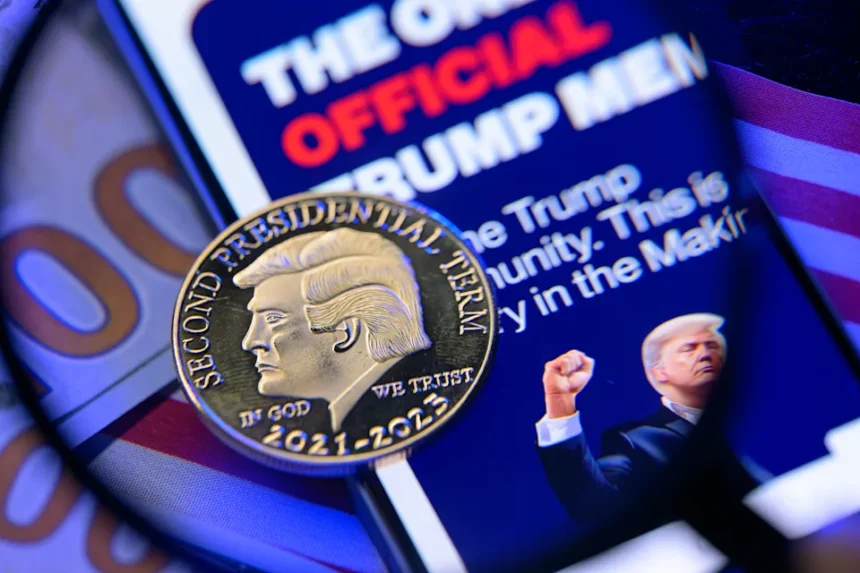
The three largest income items are distinct in character. First: $635 million in royalties from Celebration Coins, the company that licences the $TRUMP meme coin – a token that launched three days before Trump’s second inauguration, briefly peaked at $74.24, and now trades below $2, having lost more than 95% of its value from peak. Second: approximately $526 million from sales of WLFI tokens through World Liberty Financial, the crypto venture co-founded by Trump’s sons Eric and Donald Jr. and US envoy Steve Witkoff – a token down roughly 72% from its high. Third: nearly $197 million from an equity sale related to Stablecoin Holdco LLC, the entity connected to World Liberty’s USD1 stablecoin business.
The pattern across all three streams is identical: income was generated at or near launch, through token issuance and equity sales to investors, while the underlying tokens subsequently lost most of their value for the buyers who funded those proceeds. The investors who purchased WLFI tokens and the meme coin are collectively sitting on massive losses while the president, through his licensing and equity positions, extracted billions at prices that the market has since decisively repudiated. FinancialMediaGuide examines that asymmetry as the core conflict-of-interest concern embedded in the disclosure – not merely that a sitting president profited from assets he was simultaneously regulating, but that the profit was extracted from investors who lost out while the president’s policy apparatus was removing the regulatory barriers that might have required more disclosure about these risks.
The policy timeline makes the alignment explicit. Under Trump’s second term, the SEC dropped enforcement actions against major crypto exchanges. The GENIUS Act – the first federal stablecoin regulatory framework – was signed into law. A strategic Bitcoin reserve was created. Crypto-friendly regulators were appointed across the SEC, CFTC, and banking agencies. World Liberty Financial is now seeking a national trust bank charter from the Office of the Comptroller of the Currency. The administration has consistently said these policy decisions were made in the public interest and that Trump does not manage his crypto holdings personally.
Additional transactions in the disclosure have drawn independent scrutiny. Democratic lawmakers have questioned whether Trump’s pardon of Binance founder Changpeng Zhao was connected to Binance’s commercial relationship with World Liberty, whose USD1 stablecoin was selected to facilitate a $2 billion investment in Binance by Abu Dhabi-backed MGX. Separately, a UAE-linked company reportedly purchased a 49% stake in World Liberty for $500 million before the administration approved access to advanced Nvidia chips previously restricted from export to the United Arab Emirates. FinancialMediaGuide presents those transactions in sequence without asserting formal connection, finding that while no public finding has established that these deals were formally linked, the concentration of financially material decisions intersecting with entities that have substantial exposure to Trump-affiliated crypto ventures creates an accountability gap that the disclosure process alone does not close.
Traditional real estate and hospitality income remains present in the filing but is now a secondary story. Trump National Doral contributed $121 million, up from $110 million the prior year. Mar-a-Lago generated $77 million, up from $56 million. Golf clubs across Florida, New Jersey, and Scotland each contributed more than $30 million. Trump also reported holding more than $50 million in Bitcoin, between $5 and $25 million in Ethereum, and equity in CoreWeave through CIC Digital.
A May 2026 poll of 1,000 registered voters found that 62% did not trust the Trump administration to regulate crypto. Only 45% of respondents were aware of the Trump family’s profitable crypto holdings, while 73% opposed senior government officials maintaining crypto business interests. Even among Republican respondents, 59% opposed such arrangements. The White House has consistently rejected conflict-of-interest characterisations, calling them a tired Democratic narrative.
Financial Media Guide notes that the disclosure’s most significant limitation is structural rather than factual: US ethics rules allow officials to report asset values in broad ranges, with the highest category recorded only as “over $50 million,” making the total value of Trump’s crypto holdings impossible to calculate from the filing alone. The $1.4 billion income figure is therefore a floor, not a ceiling, and the actual scale of the financial interest the president holds in an industry whose regulatory environment he directly controls remains, by design, only partially visible.