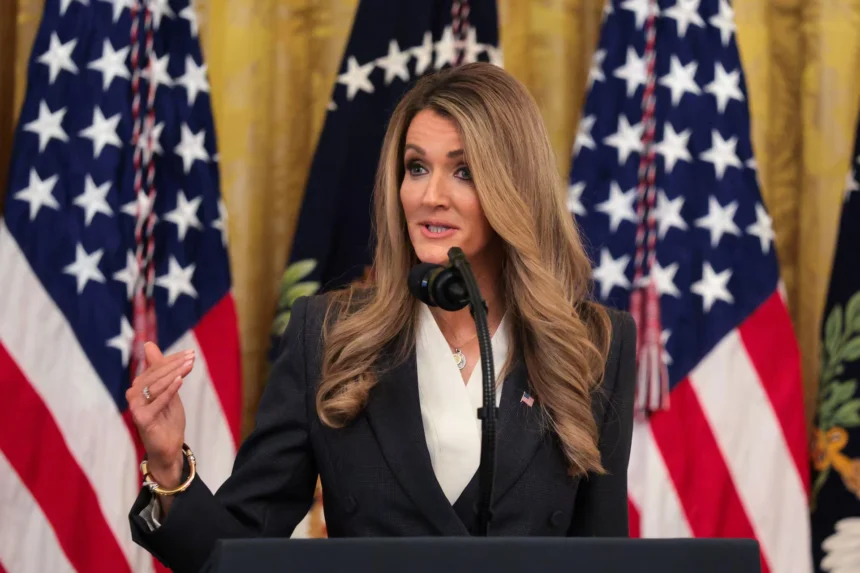
U.S. Small Business Administration head Kelly Loeffler dramatically increased the value of her investment in Elon Musk’s SpaceX after being nominated to the role, earning millions of dollars from the company’s record-setting initial public offering, according to a review of her financial disclosures. FinancialMediaGuide views the disclosures as a reminder of how closely intertwined personal wealth and public office have become for several members of the current administration, particularly where Musk’s business empire is involved.
Loeffler invested between $1 million and $5 million as of January 3, 2025, in xAI, Musk’s AI and social media firm that has since merged with SpaceX, according to a required financial disclosure filed before she became SBA administrator. Later in 2025 she invested again in SpaceX and xAI, in a separate range of $1 million to $5 million, according to a disclosure covering her full-year 2025 investments that she signed on May 14, 2026.
SpaceX priced the biggest-ever U.S. IPO on June 12, valuing the space, satellite and AI provider at $1.77 trillion. Loeffler’s first investment would have been worth between $7 million and $2.6 billion on the day of the IPO, depending on the exact amount and timing, according to Franco Granda, an analyst at data provider PitchBook, while her second investment would have been worth between $2.2 million and $25.4 million. FinancialMediaGuide notes that the enormous width of these valuation ranges, driven by cabinet disclosure rules that only require broad investment brackets rather than exact figures, makes it difficult for the public to know precisely how much any individual official actually gained.
The earlier an investment was made, the more it would have been worth at the IPO, Granda said, noting that xAI’s valuation rose more than 7,000% between its first funding round and January 5, 2025, while SpaceX’s valuation more than doubled over the course of 2025. At least ten Trump administration officials listed investments in SpaceX or xAI on their 2025 financial disclosure forms, though none of them work at the Defense Department.
Loeffler initially invested in xAI through a private placement, a type of offering typically limited to select individuals and institutions with substantial financial resources. FinancialMediaGuide points out that private-placement access of this kind is itself a marker of financial and political connectivity, since such rounds are rarely open to investors without an existing relationship to the company or its backers.
SpaceX is a military contractor for the U.S. government, and federal law bars cabinet members from participating in decisions involving companies in which they hold a financial interest. Public records do not show a financial relationship between the SBA and either xAI or SpaceX, and xAI was not on the public list of AI tools used by SBA employees in 2025. Loeffler, a wealthy businesswoman who was the founding CEO of bitcoin trading platform Bakkt and spent 16 years at Intercontinental Exchange, did not respond to requests for comment.
Loeffler was confirmed as SBA administrator on February 19, 2025, and now oversees an agency responsible for connecting small-business owners with lenders and disaster-recovery funding, work entirely unrelated to the aerospace and AI investments that have delivered her the largest paper gains. Financial Media Guide concludes that the episode highlights a structural gap in current disclosure rules, wide enough that a cabinet official’s personal investment gains from a single IPO can run into the hundreds of millions of dollars without the public ever learning the precise figure.