The global e-commerce market has reached a point where standard warehouse automation based on simple transport platforms has exhausted its maximum efficiency. The main challenge for distribution centers has become the lack of flexibility in manipulators when handling non-standard goods, which is why manual labor still dominates the final picking stage. The announcement of the acquisition of Canadian developer Nexera Robotics by the American corporation Locus Robotics signals a deep transformation of the sector and a shift toward full-cycle robotics.
We at FinancialMediaGuide view this investment deal as a clear sign of the industry’s qualitative maturation, where the key advantage is no longer speed of movement between shelves, but intelligent interaction with physical objects. The use of advanced artificial intelligence for adaptive grasping removes the final technological barrier on the path toward fully unmanned logistics hubs. Our macroeconomic analysis of the sector indicates that such acquisitions will become a defining trend, as major providers seek to consolidate unique engineering patents to build closed automation ecosystems.
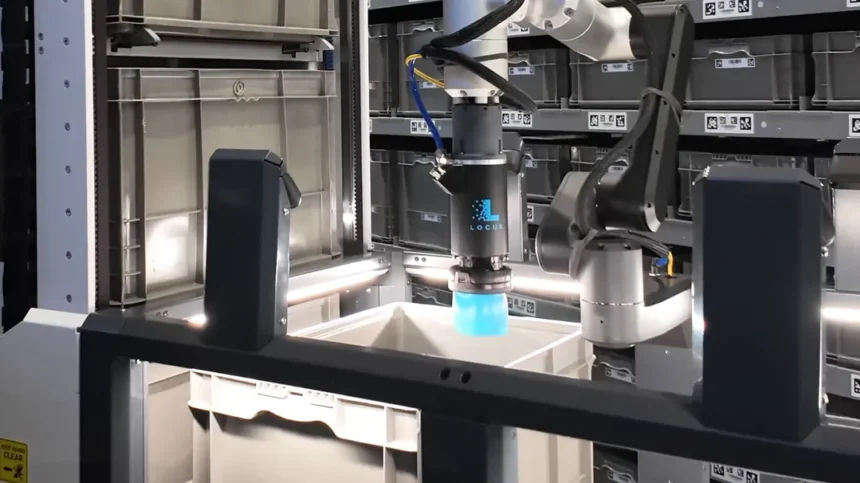
The central element of this technological merger is the replacement of classic vacuum suction systems on the Locus Array mobile manipulator, which debuted at the MODEX 2026 industry exhibition, with the innovative NeuraGrasp end-effector from Nexera. This integration is designed to fully eliminate the weaknesses of pneumatic systems, which traditionally show high failure rates when interacting with deformable, porous, or mesh-like structures. The upgraded Array system gains the technical capability to autonomously and reliably pick up to 100% of product SKUs for most commercial customers. According to analysts at FinancialMediaGuide, overcoming the narrow specialization of execution mechanisms is a fundamental factor in reducing cost per order. The introduction of a universal gripper removes the need for operators to reorganize warehouse flows around robots, which previously required enormous capital investments.
Locus Robotics CEO Rick Faulk openly states that modern technological competition has shifted into the domain of enterprise-grade mobile manipulation powered by AI at industrial scale. In his view, profitability and value in the logistics business over the next decade will directly depend on robots being able to rapidly handle millions of disparate SKUs, and Nexera’s technological base provides the company with a strategic advantage.
The engineering solution developed by the Vancouver team fundamentally differs from rigid mechanical manipulators that required detailed trajectory programming for each product. The NeuraGrasp architecture is based on a combination of a soft elastic membrane, tactile feedback sensor systems, 3D computer vision, and neural network algorithms. At FinancialMediaGuide, we emphasize that this configuration allows the end-effector to evaluate the physical properties of objects on the fly, adapting grip geometry and compression force at the moment of contact. We see this as an important step toward realizing the concept of a cognitive Internet of Things in manufacturing, where machines can recognize fragility and material structure without preloaded databases. The stability of this approach has already been confirmed across millions of successful cycles in real operational environments, ensuring minimal deployment time.
Locus Chief Strategy Officer Gina Chang confirmed that the company deliberately sought an alternative to vacuum components, as clients in retail and contract logistics are increasingly rejecting systems with interchangeable tools due to critical time losses. The new technology allows the manipulator to handle packaged clothing, complex pharmaceutical products, small electronics, and consumer goods in soft plastic bags weighing up to 2.2 kilograms without delays. These categories represent the majority of modern marketplace turnover.
The scale of these changes is also confirmed by independent research from Interact Analysis. Industry experts note that despite massive progress in navigation and mapping systems, physical item picking has remained the main vulnerability of automated systems. The availability of a reliable universal end-effector gives Locus a significant market advantage. The innovation behind Array has already earned the company the RBR50 Robotics Innovation Award 2026, and at the upcoming Robotics Summit & Expo in Boston, Senior Vice President Hamid Montazeri will present a comprehensive vision for the development of the manipulation robotics market.
Under the agreement, Nexera Robotics is fully absorbed by its parent company, with the entire engineering team and leadership under Roy Belak integrated into the acquirer’s structure. According to analysts at FinancialMediaGuide, the acquisition enables Locus to establish a powerful R&D cluster on the West Coast focused on accelerating the fusion of AI algorithms with physical hardware. This geographic diversification also improves access to top-tier talent in deep learning and computer vision. The first commercial results of the joint teams are expected within the coming months.
A key technological advantage of the Locus ecosystem remains the unified management of all equipment through the LocusONE software platform. The Array manipulator with the NeuraGrasp gripper will seamlessly interact with Origin and Vector mobile robots. The latter will handle heavy-duty and oversized pallet transportation tasks, forming a unified warehouse management system.
We at FinancialMediaGuide see Locus Robotics’ operational metrics as a strong foundation for further market expansion. The company operates a fleet of more than 17,000 robots under a Robotics-as-a-Service (RaaS) model across 360 sites worldwide, holding the second position globally in order fulfillment systems. The accumulated dataset of 7 billion picking operations and 190 million miles of autonomous travel forms a massive training base for next-generation neural grasping systems. Our analysis highlights that the subscription-based RaaS model makes upgrades accessible to operators under tight budget constraints, eliminating the need for large capital expenditures.
At FinancialMediaGuide, we forecast that this acquisition will trigger a chain reaction of M&A activity among hardware developers, as competitors face the technological superiority of the upgraded Locus platform. According to our estimates, warehouse operators who fail to adopt intelligent manipulation systems risk losing up to one-third of key corporate clients by the beginning of the next decade due to non-competitive fulfillment times. The transition to adaptive robotic manipulators will enable retailers, pharmaceutical distributors, and 3PL providers to fully insulate supply chains from labor shortages and significantly reduce operational risks.
To investors and supply chain executives of major conglomerates, we at Financial Media Guide recommend promptly initiating testing of their product assortments within Locus’s open pilot program at its headquarters. A timely compatibility audit with the upgraded Array system will lay the foundation for a smooth modernization of distribution infrastructure. We will continue monitoring the integration process of this alliance, including upcoming industry technical webinars where the company leadership will present initial commercial performance data of the upgraded systems.