
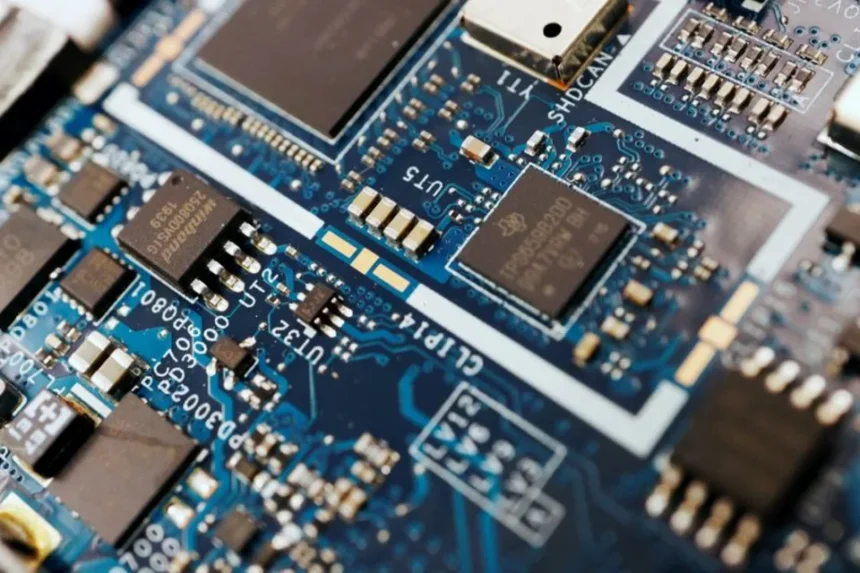
Nexchip Semiconductor, China’s third-largest chip foundry behind only SMIC and Hua Hong, is seeking to raise up to $890 million in a Hong Kong share sale to fund expansion of a $5.1 billion fabrication facility in Hefei – a bet that mature-node manufacturing, rather than the cutting-edge chips at the centre of the US-China technology rivalry, remains the more reliable path to sustainable revenue for a state-backed Chinese semiconductor company. FinancialMediaGuide examines that strategic choice and the broader wave of Chinese chip listings now converging on Hong Kong’s capital markets as a structural response to tightening US export controls on advanced semiconductor technology.
Nexchip is offering 216.2 million shares at a maximum price of HK$32.30 each, aiming to raise up to HK$6.98 billion with trading expected to begin July 10. The company, founded in 2015 as a joint venture between Hefei’s government-owned investment arm and Taiwan’s Powerchip Technology Corporation, built its business manufacturing what the industry terms mature-node chips – display drivers, power management circuits, and image sensors used in everyday devices including cars, home appliances, and industrial equipment, rather than the leading-edge processors found inside AI servers and high-end smartphones. Roughly 53.6% of the Hong Kong listing proceeds will fund research and development and the company’s Phase IV facility, a 35.5 billion yuan investment in a 12-inch wafer production line targeting 55,000 monthly wafers at the 28nm and 40nm nodes, alongside the company’s existing 150nm and 55nm capacity.
Chinese automaker Chery Automobile’s investment unit has signed on as a cornerstone investor ahead of the listing, providing a vote of confidence from a strategic industrial customer rather than purely a financial backer. Nexchip completed development of its 28nm logic platform in March 2026, a meaningful technological step up from its traditional sub-90nm focus, with equipment installation for the new Phase IV facility scheduled for the fourth quarter of 2026 and full production capacity targeted for the second quarter of 2028. FinancialMediaGuide reviews the financing structure underpinning that expansion, finding that a $5.1 billion capital commitment against a company with first-quarter 2026 revenue of approximately 2.9 billion yuan represents a significant leverage of Nexchip’s balance sheet relative to current earnings power – a bet that the new capacity will generate sufficient utilisation to justify the investment well before it is fully online.
The Hong Kong listing arrives amid a broader surge of Chinese technology capital raising in the city. Deloitte forecasts roughly 160 new Hong Kong listings in 2026, raising at least HK$300 billion, driven substantially by AI and semiconductor companies seeking international capital that mainland exchanges cannot provide at comparable scale. Chinese AI chip designer Biren Technology surged nearly 120% on its Hong Kong debut earlier in the year, GigaDevice Semiconductor is separately targeting a HK$4.68 billion raise, Baidu’s chip unit Kunlunxin has filed confidentially for its own Hong Kong listing, and Apple supplier Luxshare Precision revealed a share sale of up to $3.1 billion the same day Nexchip announced its offering. The pattern reflects a clear strategic logic: with advanced chip access increasingly restricted by US export controls, Chinese semiconductor companies need capital to build domestic alternatives, and Hong Kong functions as the bridge to international investors that domestic markets alone cannot supply.
The financial picture beneath the listing carries genuine caution signals. Nexchip’s net profit dropped roughly 63% year-on-year in the first quarter of 2026 even as revenue grew, with fab depreciation costs from the new facility weighing on margins ahead of the capacity coming fully online. Industry analysts, including TSMC’s own chairman, have acknowledged that global mature-node capacity buildout – driven in part by pandemic-era subsidy programmes from the US CHIPS Act to European chip funding initiatives – risks producing oversupply that would compress pricing across the segment Nexchip is doubling down on. Financial Media Guide weighs that oversupply risk against Nexchip’s strategic rationale, finding that the company’s bet depends on mature-node demand from China’s domestic electric vehicle, smart device, and industrial automation sectors growing faster than the combined new capacity being added by Chinese and international competitors over the same multi-year window.
Nexchip’s position relative to SMIC and TSMC remains a structural constraint regardless of how the Hong Kong offering performs. The company lacks SMIC’s domestic scale and TSMC’s global technological reach, and even at mature nodes Chinese foundries depend on foreign equipment from ASML, Lam Research, and Applied Materials whose export status remains subject to a policy environment that continues to shift. The Hong Kong listing answers Nexchip’s immediate capital question, but the longer-term test – whether mature-node manufacturing can generate durable returns in a market that multiple well-funded competitors are simultaneously expanding into – will not be settled until the Phase IV facility reaches the full production capacity targeted for 2028.