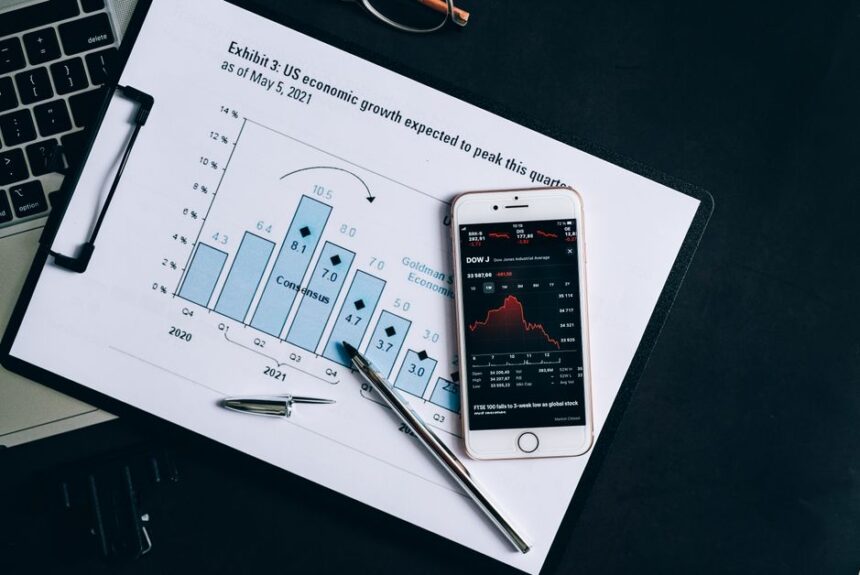
The global economy is entering a period where even the most sophisticated analytical frameworks struggle to produce a unified picture. A recent McKinsey & Company survey of senior executives and economists reveals a striking absence of consensus on where the world economy is headed – with respondents split across scenarios ranging from moderate recovery to prolonged stagnation. That fragmentation itself carries a signal: when informed observers cannot agree, markets and businesses face a structurally elevated level of uncertainty that shapes investment decisions, hiring plans, and capital allocation in real time.
According to FinancialMediaGuide analysts, this divergence is not simply a reflection of incomplete data. It mirrors the genuinely bifurcated nature of current macroeconomic conditions, where GDP growth trajectories, inflation dynamics, and central bank policy paths are pulling in different directions across major economies simultaneously.
Inflation remains the central variable around which most disagreement clusters. In the United States, the Federal Reserve has maintained elevated interest rates for an extended period following its aggressive tightening cycle that began in 2022. While headline inflation has declined from its peak above 9% in mid-2022, core inflation has proven more persistent, keeping the Fed in a holding pattern that has direct consequences for global trade, capital flows, and emerging market debt servicing costs.
The IMF, in its most recent World Economic Outlook, projected global GDP growth at around 3.2% for 2024 and 2025 – a figure that sits below the historical average and reflects what the fund describes as a “sluggish” expansion. The World Bank has similarly flagged that the global economy is on track for its weakest half-decade of growth in 30 years. These institutional projections, however, are themselves contested. Private sector forecasters and corporate strategists surveyed by McKinsey show a much wider distribution of expectations, with a meaningful share anticipating either a sharper slowdown or a more resilient outcome than the baseline suggests.
We at FinancialMediaGuide see this as a structural feature of the current cycle rather than a temporary analytical gap. The post-pandemic economy has introduced non-linear dynamics – supply chain rewiring, fiscal dominance in several major economies, and geopolitical fragmentation of global trade – that make standard forecasting models less reliable than they were in previous cycles.
The Federal Reserve’s monetary policy stance continues to anchor global financial conditions. When the Fed holds rates at restrictive levels, borrowing costs rise across the world, dollar-denominated debt becomes more expensive to service, and risk appetite in equity and credit markets compresses. The European Central Bank moved to cut rates earlier in 2024, creating a policy divergence with the Fed that has added volatility to currency markets and complicated the export calculus for eurozone manufacturers.
Global trade has become an additional fault line in the economic outlook debate. The re-escalation of tariff measures between the United States and China, combined with broader industrial policy shifts in the EU and elsewhere, is restructuring supply chains in ways that carry both inflationary and deflationary pressures depending on the sector and geography. For businesses operating across borders, the cost of compliance, rerouting, and inventory buffering has risen materially.
The recession question remains unresolved. The United States avoided a technical recession in 2023 despite aggressive rate hikes, supported by a resilient labor market and sustained consumer spending. Yet leading indicators – including inverted yield curves, tightening credit standards, and slowing manufacturing output – have kept recession risk on the table for 2024 and into 2025. In Europe, Germany has already experienced consecutive quarters of contraction, and the broader eurozone has skirted recession by narrow margins.
FinancialMediaGuide analysts forecast that the absence of consensus will itself become a market-moving factor. When institutional investors, corporate boards, and policymakers operate from incompatible baseline assumptions, capital allocation becomes more conservative, M&A activity slows, and long-duration investment projects face higher hurdle rates. That behavioral response can, in aggregate, produce the slowdown that no single forecast confidently predicted.
The McKinsey findings point to a deeper challenge for economic governance. Central banks, including the Federal Reserve, are navigating a transition from crisis-mode monetary policy back toward something resembling neutral – but the definition of neutral has shifted. Neutral interest rates appear structurally higher than pre-2020 levels, which means the economy must adapt to a more expensive cost of capital as a baseline condition rather than a temporary constraint.
In our view at FinancialMediaGuide, the practical implication for businesses and investors is a need to build scenario resilience rather than optimize for a single forecast. The McKinsey survey underscores that even well-resourced analytical teams cannot converge on a central case with confidence. Portfolios and corporate strategies built around a single GDP growth or inflation assumption carry more model risk than the numbers themselves suggest. The global economy is not broken – but it is operating in a regime where the distribution of outcomes is wider, the feedback loops between policy and growth are less predictable, and the cost of being wrong about the baseline is higher than it has been in decades.