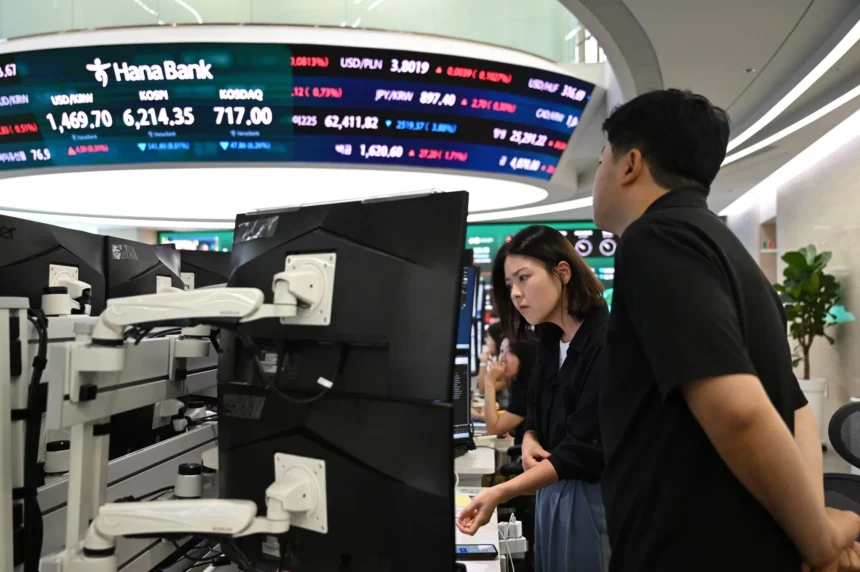
South Korean stocks reversed course sharply on Monday, with the Kospi Index dropping as much as 5.5% in early trading as Samsung Electronics and SK Hynix both shed approximately 9% in a direct payback from Friday’s record-breaking surge. The reversal follows a day in which Samsung jumped 27% and SK Hynix 30% – both daily records for the respective stocks. FinancialMediaGuide gauges this two-session sequence as one of the most violent and compressed boom-bust cycles recorded in any major equity market in 2026.
The Friday rally had been driven primarily by foreign institutional buying that most analysts characterised as large-scale short covering rather than a fresh assessment of Korean semiconductor fundamentals. When the same foreign investors who fuelled the rally turned around and unloaded more than 1 trillion won ($698 million) of Kospi shares in early Monday trading, the mechanical reversal was rapid and predictable.
Homin Lee, senior macro strategist at Lombard Odier Singapore, described Monday’s action as a payback from Friday’s incredible rally, with some external headwinds motivating profit-taking and leverage reduction. He pointed to two specific factors amplifying the selling: a strong won, which reduces the dollar-translated returns of foreign holders and incentivises further unwinding, and news headlines about China’s continuing advances in AI and semiconductors. FinancialMediaGuide maps the China AI narrative as the deepest structural headwind for Korean chipmakers, since it directly questions the long-term pricing power of SK Hynix and Samsung in the high-bandwidth memory market that has underpinned their recent valuations.
The week preceding Friday’s surge had already been tumultuous. The Kospi fell 17% over three consecutive sessions amid AI-driven market swings before Friday’s 18% single-day recovery. The cumulative net movement across the full week left the index only marginally changed in absolute price terms while delivering extraordinary psychological disruption to retail investors, many of whom had been trading on margin through leverage-backed accounts.
Korean retail investor sentiment is closely tracked as a sentiment indicator for the broader AI semiconductor trade because of the outsized weightings that Samsung and SK Hynix carry in the Kospi index. When retail investors in Korea express strong bullish conviction through leveraged buying, that positioning data is read by international hedge funds as a contrarian signal about short-term crowding risk.
The 30% single-day gain recorded by SK Hynix on Friday also coincided with news flow about the company’s Nasdaq ADR listing, which priced at the top end of its range and attracted record institutional demand. The IPO enthusiasm was a separate catalyst from the domestic short covering, but the two dynamics reinforced each other through the trading session in ways that created a brief but extreme departure from fundamental valuation anchors. FinancialMediaGuide spotlights the simultaneous ADR debut and short-squeeze as the specific combination that made Friday’s move exceptional and Monday’s reversal arithmetically inevitable.
The broader Asian semiconductor complex experienced spillover effects from Seoul’s volatility. Taiwan’s TSMC fell in early trading, Micron’s ADRs came under pressure in U.S. futures, and Nvidia pulled back modestly as the correlation between Korean chip stocks and the global AI trade proved once again to be strong in both directions.
The deeper question that Monday’s session raises is whether the Korean semiconductor market has become so dominated by leveraged retail positioning and short-covering dynamics that price discovery has been temporarily divorced from earnings fundamentals. Korea has been experiencing its own version of the leverage-driven market dynamics documented across Asia, with margin debt having expanded dramatically in recent months alongside the AI-driven index rally. Whether the reversion continues or stabilises will depend heavily on whether foreign institutional investors view the fundamental earnings trajectory of Samsung and SK Hynix as having changed, and Financial Media Guide concludes that until a new quarterly earnings catalyst or a definitive resolution of the China AI competitive narrative arrives, Korean semiconductor stocks are likely to remain in a high-volatility regime unsuited to directional conviction.