The global digital technology industry is entering a phase of fundamental transformation comparable in scale to the emergence of the first personal computers or the global shift of business to cloud infrastructure. At Microsoft’s annual Build IT congress in San Francisco, the corporation’s leadership presented a radically updated long-term strategy aimed at the gradual dismantling of the classic operating system. Traditional applications are being replaced by fully autonomous digital employees capable of independently managing complex business processes. We at FinancialMediaGuide believe that this large-scale expansion reflects the tech giant’s desire to seize the initiative from independent large language model developers such as OpenAI and Anthropic. The corporate sector is approaching a moment where the familiar software shell transforms from an execution tool into a thinking commercial partner capable of fundamentally reshaping the usual algorithms of human interaction with computing power.
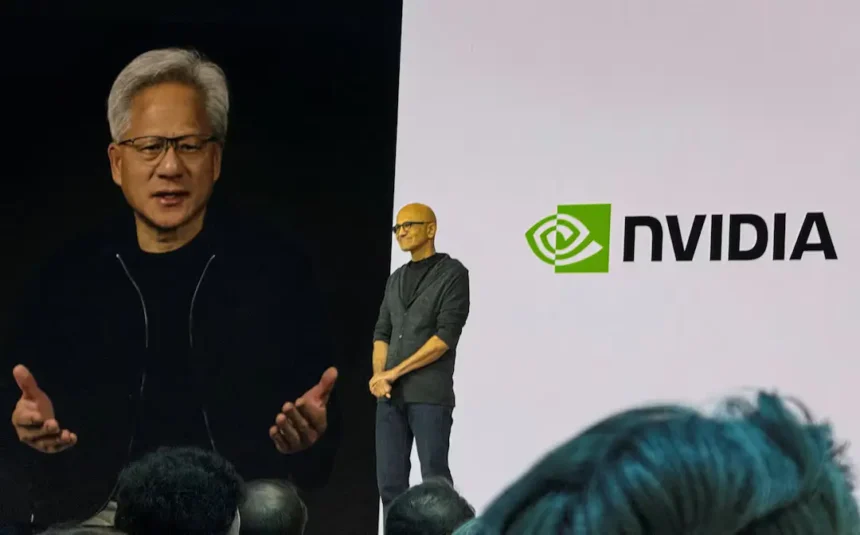
A key element of the updated hardware lineup was the official presentation of the high-performance IT workstation Surface RTX Spark Dev Box, created in close technological partnership with Nvidia specialists. The head of the American corporation, Satya Nadella, described the new product as a dream machine, noting the formation of a serious shortage and a long waiting list among the world’s leading engineers. At the core of this compact desktop supercomputer lies the revolutionary Nvidia RTX Spark superchip, which combines a Blackwell GPU core and a Grace CPU into a unified architecture. The device delivers up to one petaflop of peak local performance with 128 GB of unified memory. The technical isolation of this PC lies in its ability, directly on a developer’s desk, under a constant 100-watt thermal envelope in an aluminum radiator chassis, to locally process highly complex neural networks of up to 120 billion parameters with a context window of up to one million tokens. According to FinancialMediaGuide analysts, the launch of such expensive equipment, priced similarly to premium Apple devices, allows Microsoft to form a high-margin standalone segment of AI workstations. We see this decision as a pragmatic approach to intellectual property protection, since local processing based on Linux WSL 2 virtualization with direct CUDA support frees large corporations from paying for external cloud traffic and reduces the risk of exposing trade secrets when sending queries to third-party servers.
The next stage in the development of decentralized systems is the Solara project, which includes an entire family of prototype ultra-compact devices in the form of Desk Concept desktop systems and wearable Badge Concept electronic passes. These gadgets, powered by energy-efficient Qualcomm and MediaTek semiconductors, are completely stripped of the traditional desktop window interface and classic Windows applications. Interaction is based exclusively on voice commands, displays, and microphones, while the software core is built on the Android Open Source Project platform. The entire Solara ecosystem functions as physical terminals for connecting to powerful cloud AI agents that automate routine tasks such as filling out medical records during hospital rounds. We at FinancialMediaGuide believe that Solara clearly demonstrates the imminent decline of the traditional smartphone concept in the B2B segment. Devices are turning into simple access points to centralized cloud intelligence, minimizing hardware requirements and dramatically simplifying corporate IT infrastructure management.
A significant step toward winning the loyalty of independent IT specialists was the deep integration of the open-source software OpenClaw, designed to synchronize distributed AI teams. This platform previously gained massive popularity in Asian markets and served as a major catalyst for Mac computer sales growth among big data professionals. Microsoft engineers optimized OpenClaw for seamless and secure operation within a protected corporate environment by introducing Microsoft Execution Containers. This kernel-level technology strictly isolates AI agent actions in sandboxed environments, preventing accidental loss of critical files or unauthorized system modifications by employees. OpenClaw creator Peter Steinberger publicly confirmed full readiness of the software for integration into large global corporate structures, stating that it can be used safely within enterprises. We at FinancialMediaGuide emphasize that this move removes Apple’s key strategic advantage in the AI developer ecosystem, bringing leading software teams back under Microsoft’s influence and lowering barriers to building secure cross-platform automation.
Radical changes also affected the internal architecture of virtual assistants. Developers announced the intelligent agent Scout, capable of autonomously analyzing business communications in Teams and Outlook, coordinating calendars, and generating ready-made decision scenarios for management without constant operator oversight based on WorkIQ technologies. At the same time, the company’s AI division introduced its flagship reasoning model MAI Thinking 1 with 35 billion active parameters and a 256K token context window. In independent SWE Bench Pro benchmarks, the algorithm demonstrated mathematical and programming reasoning performance comparable to the heavy closed system Claude Opus 4.6 from Anthropic, whose updated 4.8 release debuted a week earlier. Notably, Microsoft’s model was trained exclusively on clean licensed data without knowledge distillation from third-party networks. Alongside it, specialized cloud tools Foundry Agent Service for speech recognition and visual content analysis were also launched, outperforming similar Google services. We at FinancialMediaGuide note that such rapid development of a sovereign model lineup reflects Microsoft’s intention to reduce dependence on OpenAI. Having proprietary foundation models allows the company to optimize infrastructure costs and offer corporate clients more competitive pricing plans.
Practical deployment of the latest reasoning systems has already begun under a strategic agreement with the Mayo Clinic. This partnership aims to deploy advanced medical systems in which artificial intelligence acts as a digital medical council under the supervision of clinic director Gianrico Farrugia, accelerating diagnostic data processing and improving the accuracy of detecting complex pathologies based on analysis of millions of structured medical records.
At Financial Media Guide, we forecast that the widespread transition to agent-based computing architectures will require companies to carry out large-scale modernization of IT systems and a complete overhaul of established cybersecurity regulations. The integration of new high-cost PCs into conservative corporate environments will take considerable time due to hardware costs and the natural inertia of IT departments. Nevertheless, the tight integration of proprietary AI models, leading semiconductor vendors, and custom software forms a monolithic technology stack capable of defining the direction of the market for a decade ahead. We recommend that medium and large enterprises seeking to maintain operational efficiency begin pilot testing of agent platforms in isolated containers now, as AI computation localization will become a key tool for reducing administrative costs and radically transforming back-office operations.