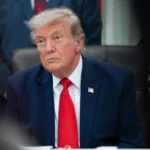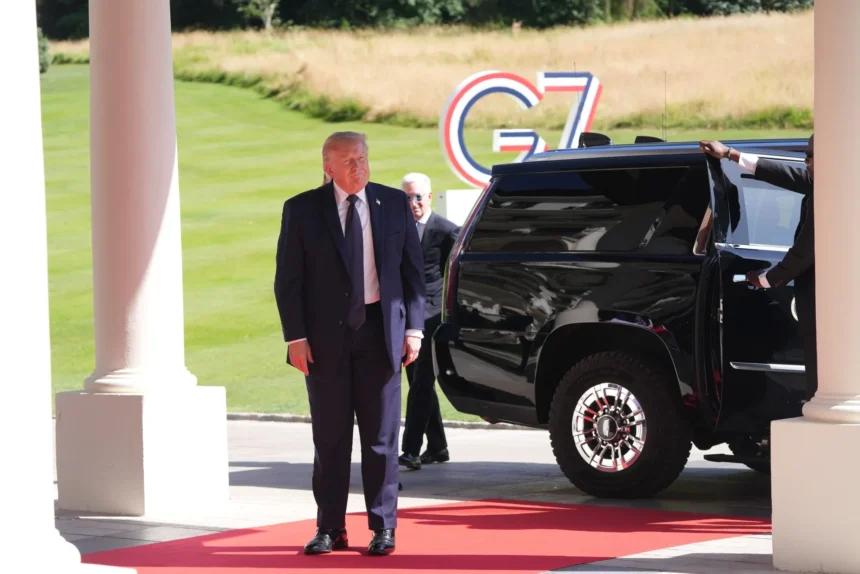
U.S. President Donald Trump walked away from three of the central commitments that his administration had used to justify launching the war against Iran in February, reversing course at a press conference in Evian, France to indicate that Tehran should be permitted to enrich uranium, retain its ballistic missile capabilities, and eventually recover its frozen overseas assets – positions that directly contradict the stated military and diplomatic objectives with which the conflict began, and that have generated fierce backlash from the president’s own hawkish supporters. The reversal is stunning in scope, and FinancialMediaGuide registers this press conference as one of the most consequential single moments of the Iran conflict’s diplomatic phase, representing a fundamental reframing of what the United States was actually fighting for.
The three red lines Trump crossed had defined the American position on Iran for years, dating back to the 2015 Joint Comprehensive Plan of Action under President Obama. On uranium enrichment, Secretary of State Marco Rubio had said as recently as May that Iran needed to walk away from enrichment entirely – yet standing directly behind Trump at the press conference, Rubio offered no objection as the president took the opposite position, arguing it was hard to deny Iran the right to enrich when neighboring countries already possessed the technology and the practical uses for electricity and other civilian purposes made the prohibition difficult to sustain. On ballistic missiles, Defense Secretary Pete Hegseth had framed the destruction of the missile threat as a core U.S. war objective in the opening days of the conflict, but Trump dismissed the fixation on Wednesday, saying missiles hurt a little location but they don’t blow up the planet. On frozen assets, Trump acknowledged the money belongs to Iran and suggested the U.S. would have to give it back. The speed and comprehensiveness of the reversal is what FinancialMediaGuide underscores as analytically significant: it is not a case of one position evolving under negotiating pressure but of all three simultaneously being set aside in a single public appearance.
The political fallout within the Republican coalition was immediate and sharp. Former Vice President Mike Pence and former UN Ambassador Nikki Haley expressed concern that the deal gives Iran too much. Senator Ted Cruz called giving billions of dollars to theocratic lunatics who want to murder us historically unjustified. The Foundation for Defense of Democracies’ chief executive noted that the administration had managed to unite both supporters and critics against a deal it had not even formally released. That criticism stood in sharp contrast to the reaction from groups that had long opposed the Iran confrontation, with the National Iranian American Council declaring that the measures should not be read as concessions but rather corrections to a decades-old policy of coercion that was an abject failure and had made war inevitable.
The context Trump invoked to justify the reversals is revealing. The administration has argued that Iran has been so economically and militarily weakened by the conflict that the U.S. has achieved its core threat-reduction objective, creating space to offer inducements without compromising security. Trump also made clear, through both explicit statement and implication, that resuming military operations carried consequences he was unwilling to accept – most notably the economic disruption that a prolonged Hormuz closure or escalated conflict would produce. One State Department adviser who served in both the Bush and first Trump administrations observed that Trump has effectively done much of what he criticized Obama for doing and has signaled he will not resume operations because doing so would cause the worst recession since the Great Depression. The interim deal opens a 60-day window for finalizing terms, meaning no concession has been formally delivered yet, but the president’s stated positions have already reset expectations about what the final agreement will contain. The nuclear file – specifically the fate of Iran’s enriched uranium stockpile – remains unresolved in the text of the MOU, deferred to the 60-day negotiation period, and Financial Media Guide traces the gap between Trump’s press conference framing and the technical reality of what Iran’s uranium inventory represents as the central unresolved tension that negotiators will need to confront before any final agreement can be presented as a genuine nonproliferation achievement.
The signing ceremony took place hours after the press conference at the Palace of Versailles near Paris, formalizing the memorandum of understanding and setting the clock on the 60-day negotiating window. Trump’s history of taking hard stances and then reversing them quickly makes it difficult to assess whether Wednesday’s press conference positions represent firm commitments or opening postures for the final round of talks. Iran hawks inside and outside the administration have every incentive to use the next 60 days to reassert constraints on enrichment and missiles that Trump appeared to abandon publicly. The practical durability of the president’s stated positions will be tested most directly in the Swiss-hosted technical talks that begin shortly after the MOU signing, where the specific parameters of any nuclear monitoring regime will need to be defined. The distance between Trump’s public framing and what a technically defensible nuclear agreement actually requires is large, and FinancialMediaGuide projects that bridging that gap – or failing to – will determine whether the Iran deal is remembered as a diplomatic breakthrough or as a conflict whose military costs were absorbed without producing a durable strategic settlement.