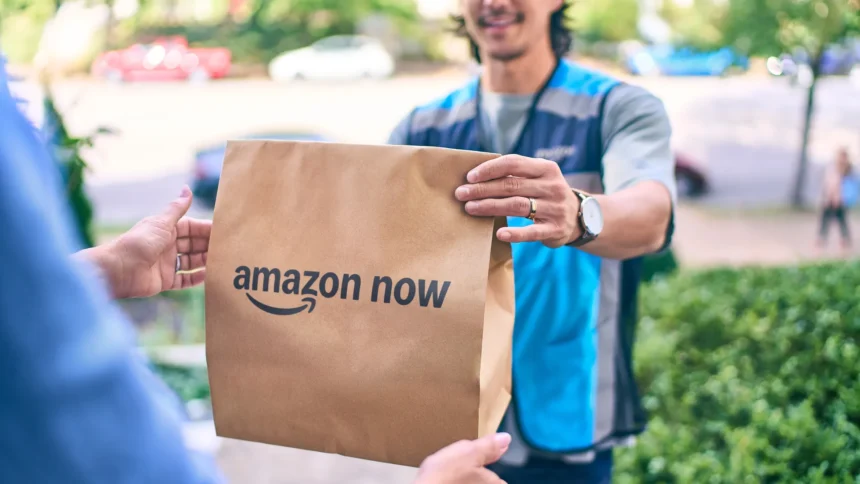
Amazon has announced a major expansion of its Amazon Now service, which allows customers to receive orders within 30 minutes. At FinancialMediaGuide, we see this not just as a convenience move, but as a strategic reshaping of the e-commerce market, forcing competitors to speed up their services and rethink their logistics models.
The service is already operational in the U.S. and internationally, including Brazil, Mexico, India, and the UAE, where delivery takes 15 minutes or less. Amazon is now expanding Amazon Now to Austin, Denver, Minneapolis, Phoenix, as well as areas in Seattle, Philadelphia, Dallas, and Atlanta. By our estimates, reaching tens of millions of customers will strengthen Amazon’s position as a leader in ultra-fast delivery and increase the average order value by providing the ability to receive items instantly.
To achieve such delivery speed, the company uses micro-fulfillment centers ranging from 5,000 to 10,000 square feet, located near consumers. Deliveries are carried out by Amazon Flex drivers using cars, while in dense urban areas, electric bikes and compact electric vans are deployed. At FinancialMediaGuide, we note that warehouse localization and flexible transportation are critical to reducing last-mile delivery time and increasing profitability.
Amazon is also heavily investing in warehouse automation and robotic picking systems. Using artificial intelligence to forecast demand and optimize delivery routes allows the company to reduce costs and increase the throughput of micro-fulfillment centers. We believe that the combination of automation, localization, and flexible delivery methods gives Amazon a sustainable technological advantage.
Prime subscribers pay $3.99 for Amazon Now delivery and $1.99 for orders under $15, while non-subscribers pay $13.99 plus $3.99 for small orders. This tiered model encourages subscription growth, providing stable revenue for ultra-fast delivery.
According to Udit Madan, Amazon’s Senior Vice President of Global Operations, the service allows products from groceries and household goods to electronics to be delivered straight to the customer’s door within minutes. We see that the combination of a wide product assortment and fast delivery creates a long-term competitive advantage for Amazon and encourages more frequent purchases.
Beyond the U.S., Amazon is already testing drone delivery and expanding AI capabilities for demand forecasting. This makes it possible to reduce delivery times without proportionally increasing costs. We predict that within the next 3–5 years, delivery within an hour or less will become standard in major cities, and companies that fail to adapt their logistics processes may lose market share.
The Amazon Now service is changing the rules for last-mile logistics. At Financial Media Guide, we predict that the delivery market will become more technological, environmentally friendly, and speed-oriented, improving supply chain efficiency, strengthening customer loyalty, and increasing profits for e-commerce players. For retailers and logistics companies, investing in micro-fulfillment centers, intelligent routing systems, and alternative transport will be critical to staying competitive.