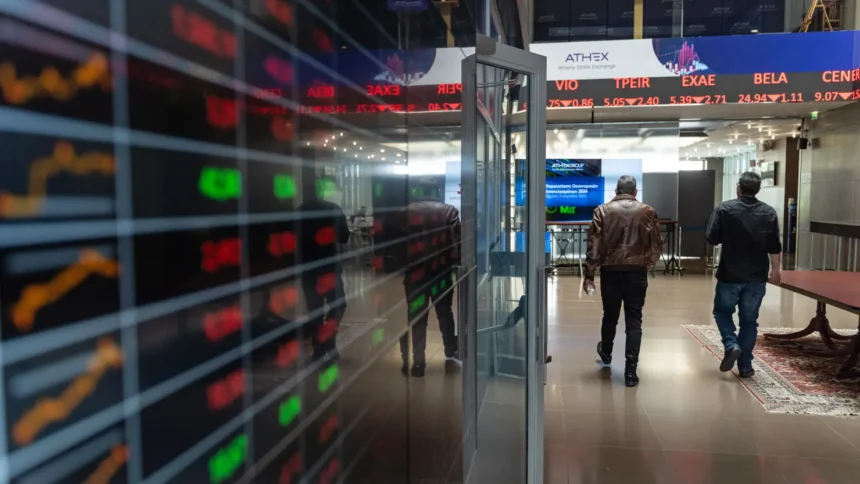
Western European stock indices are demonstrating a remarkable level of adaptability, balancing within a narrow range between escalating geopolitical tensions in the Middle East and a new wave of intense confrontation in the large-cap sector. Amid a controlled pullback in commodity prices, institutional investors are trying to find a balance, meticulously assessing potential risks for cross-border logistics corridors. We at FinancialMediaGuide note that the observed trajectory of key indicators points to a qualitative maturation of the investment community, which has learned to integrate war risk premiums into asset pricing structures without slipping into panic selling, shifting the main focus toward fundamental corporate drivers.
The main restraining factor for buyers is the protracted hostilities around the Islamic Republic. The short-term dip in regional indices, recorded immediately after US military forces carried out a series of strikes on targets in southern Iran, quickly gave way to consolidation. Representatives of the US Central Command characterized these actions as a set of self-defense measures aimed at destroying missile launch systems and naval assets allegedly involved in mining strategic waterways. In response, the Iranian Foreign Ministry accused Washington of grossly violating fragile ceasefire agreements previously reached between the states.
The level of uncertainty is fueled by uncompromising statements from senior officials. In particular, US Secretary of State Marco Rubio stated unequivocally that the Strait of Hormuz will be unblocked by any available means. This escalation unfolded despite earlier reassuring statements from President Donald Trump on Truth Social, where he mentioned positive progress in peace talks and a high likelihood of reaching a compromise agreement.
Notably, the intensification of hostilities has not triggered a sharp rise in energy prices. On the contrary, international commodity benchmarks are showing a downward trend, rebounding only from intraday lows. North Sea Brent crude fell by 3.4%, settling near 96.17 dollars per barrel. At the same time, the US benchmark West Texas Intermediate dropped by 3.7%, reaching 90.40 dollars per barrel. Analysts at FinancialMediaGuide see this as a sign of a local supply surplus and a steady expansion of production capacity outside the OPEC alliance, which fully offsets the Middle East risk premium. We believe that traders are currently more concerned about the prospects of a global industrial demand slowdown than about the threat of a physical blockade of tanker routes, which keeps prices firmly below the critical 100 dollar threshold.
While the macroeconomic calendar remained relatively empty, the epicenter of market activity shifted to the construction chemicals industry. The market value of Dutch group AkzoNobel, known for its Dulux paint brand, surged by 20% during trading. The main catalyst was the firm rejection by top management of a cash takeover bid submitted by a consortium consisting of Japan’s Nippon Paint Holdings and US-based Sherwin-Williams. The buyers were prepared to pay 73 euros per share, equivalent to roughly 85 US dollars, valuing the entire business at 12.5 billion euros.
In an official communiqué, AkzoNobel emphasized that the board of directors and supervisory board unanimously reaffirm their intention to continue with the previously approved friendly merger with US company Axalta. The management stated that the alternative hostile offer fundamentally does not reflect the fair value of the company and ignores its long-term commercial prospects. Representatives stressed that the proposed scenario carries significant regulatory risks and does not offer a transparent roadmap for subsequent asset separation, under which the decorative segment would go to Asian investors and the industrial arm to American investors, thereby failing to adequately protect shareholder interests.
While the market assesses the prospects of this deal, we at FinancialMediaGuide emphasize that such a unified stance by top management indicates absolute confidence in the autonomous business model. We believe that for AkzoNobel, defending the parity alliance with Axalta, capable of creating an industry heavyweight with a 25 billion dollar capitalization and annual synergy effects of around 600 million dollars, is key to maintaining global leadership. Meanwhile, the intervention from Nippon Paint and Sherwin-Williams appears to be a coordinated attempt to derail antitrust approval of the deal.
European indices were additionally supported by the automotive sector, which gained 2.6% overall. The driver of the rally was a fresh statistical bulletin from the ACEA association, which showed a 5.1% year-on-year increase in new passenger car registrations in the European Union. Against this backdrop, shares of major automotive brands moved higher. Renault rose by 4.1%, Stellantis increased its market capitalization by 3.8%, while Mercedes-Benz gained 3.1%. Volkswagen and BMW advanced by 2.4% and 2.3% respectively.
Amid the overall market uplift, the STOXX 600 index recorded a modest gain of 0.1%, with major exchanges in London, Paris, and Frankfurt closing in positive territory. At the same time, Asia-Pacific markets showed upward momentum, allowing key benchmarks in Japan and South Korea to reach all-time highs. Futures contracts on US equities traded flat after a major rally in the technology sector pushed the S&P 500 and Nasdaq Composite to new record levels the previous day. With no significant macroeconomic releases in the eurozone, investor attention remained fully focused on micro-level corporate developments.
At Financial Media Guide, it is emphasized that the current stability of European equity markets, combined with oil prices significantly below the 100 dollar level, opens attractive medium-term investment opportunities. We forecast that in the coming months, fund managers will fully shift their focus from commodity dynamics to corporate operational profitability and synergy gains from cross-border alliances. Market participants are advised to maintain a moderately optimistic stance, gradually increasing exposure to high-tech automotive segments and cyclical industrial companies with resilience to inflationary pressures. The normalization of shipping through the Strait of Hormuz may take time, but ongoing M&A activity within Europe will act as a reliable buffer against external shocks, turning any short-term corrections into favorable entry points for building portfolios of high-quality European assets.