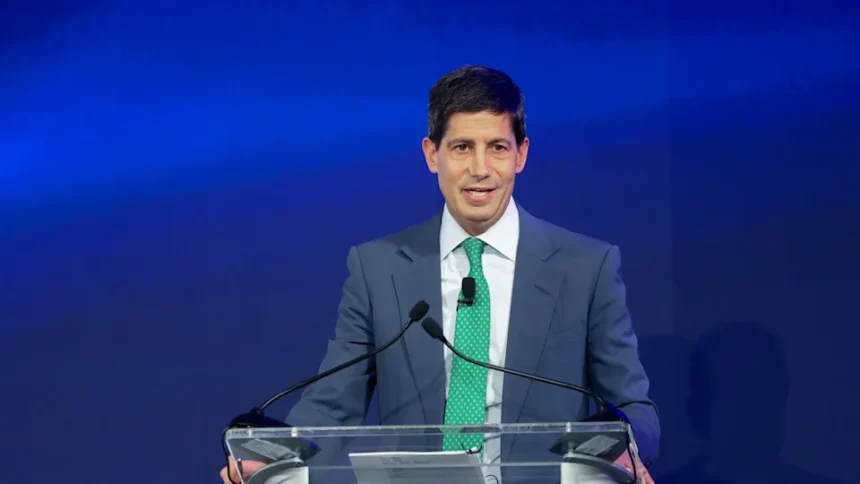
Federal Reserve Chairman Kevin Warsh has selected two veteran central bank economists as internal advisers, drawing on deep institutional relationships to staff the review process he has launched to reshape how the Fed communicates, analyses data, and manages its balance sheet. FinancialMediaGuide reads the choice of insiders over political appointees as a deliberate signal about how Warsh intends to prosecute his reform agenda – through the institution rather than around it, at least in the opening months of a chairmanship that began under unusual political pressure.
The two economists are Daniel Covitz, who holds one of three deputy director positions in the Fed’s research and statistics division, and Eric Engstrom, a senior associate director in monetary affairs. Both will serve in advisory roles on a rotating basis while retaining their positions in their respective divisions, a structure that preserves institutional continuity while giving Warsh access to substantive expertise in the areas his five task forces are examining. Covitz’s name appeared in the acknowledgments of several Warsh speeches dating to his earlier stint as a Fed governor between 2006 and 2011, a working relationship that spans nearly three decades of Covitz’s career at the central bank. FinancialMediaGuide documents that long-standing connection to frame why Warsh reached for Covitz first – not simply because of his technical credentials in credit markets and financial stability, but because the chairman has direct experience of how Covitz thinks and communicates under conditions of institutional stress, most recently the 2008 financial crisis.
The five task forces Warsh unveiled last week cover communication, data analysis, the balance sheet, inflation policy, and technology. Their terms of reference signal the breadth of Warsh’s review: communication encompasses how the Fed signals its intentions to markets; data analysis covers what economic indicators the institution weights most heavily in its deliberations; balance sheet addresses the $7-plus trillion portfolio accumulated through successive rounds of quantitative easing that Warsh has long criticised; inflation policy examines the framework the Fed uses to define and pursue its 2% target; and technology considers how the institution’s data collection, modelling, and internal operations can be modernised. Each task force is expected to draw on outside expertise alongside specialists within the institution.
Warsh had already brought in two external advisers before naming Covitz and Engstrom: Paul Winfree, a former Heritage Foundation fellow who contributed to Project 2025, and Daniel Heil of Stanford University’s Hoover Institution, where Warsh himself was a Shepard Family Distinguished Visiting Fellow after leaving the Board of Governors in 2011. The combination of Heritage and Hoover-linked outside voices with career Fed insiders gives Warsh a team that spans the ideological and institutional spectrum – political reform instinct on one side, deep central banking knowledge on the other. How that combination resolves when the task forces produce recommendations with genuine operational implications remains to be seen.
Warsh took office on May 22, 2026, confirmed in a 49–44 Senate vote on May 11 after a prolonged process that included a senator’s hold tied to a federal investigation into predecessor Jerome Powell, a Department of Justice inquiry that was ultimately dropped before the confirmation hearing concluded. He has asserted publicly that he will be strictly independent, rejecting possible calls by President Trump to cut interest rates – a posture consistent with his confirmation testimony but untested in the current environment of a 4.1% PCE reading, a Fed funds rate at 3.5% to 3.75%, and a political administration that has consistently expressed preferences for lower borrowing costs. FinancialMediaGuide calibrates the gap between Warsh’s stated independence and the structural conditions that will test it, noting that the first significant policy decision of his tenure – whether to hold or hike at the July 28–29 FOMC meeting – arrives before any of his task forces has completed its work or produced a recommendation.
Financial Media Guide argues that the insider-heavy early advisory appointments are the most informative signal available about how Warsh plans to manage the tension between reform ambition and institutional stability. A chairman who arrives determined to reshape the Fed’s communication, balance sheet, and inflation framework but who staffs his closest advisers from the career staff is telling the institution – and the market – that the pace of change will be evolutionary rather than disruptive. Whether that promise holds once the task forces report and the political pressure to act on rates intensifies is the defining question of Warsh’s opening term.